
Adult Violin Lessons, Online, One to One
A violin teacher for adults: beginners, returners and professionals
A 50-minute working lesson that begins with your sound and follows the question that matters most.
The work can begin with your first notes or with questions that emerge after years of playing.
Why this works online
You develop your own ear faster. Without a teacher physically present to adjust the instrument for you, you build independent listening habits from the start. That awareness travels with you into every practice session.
The work stays focused and easier to sustain. These are violin lessons on Zoom, private violin lessons online with nobody else in the room, and a well-set-up connection gives us enough detail to work closely with articulation and bow contact. Because the lesson happens where you practise, it is easier to keep these virtual violin lessons present in a demanding adult schedule.
What Happens in a Lesson
The lesson begins where you are, with the music you are working on and the question that feels most alive. That becomes the material.
We choose one thing and stay with it long enough to understand what is happening. It might be a bow-arm question or a phrase that will not breathe. Historical context enters when it gives the problem a clearer shape.
You leave with a concrete result you can use in practice – perhaps a physical awareness or a different way of hearing. The aim is one change that alters how the instrument feels under your hands.
Historical Context as a Working Tool
Historically informed performance enters the lesson as a source of practical information. You can work on a modern violin or a period setup.
Geminiani’s left-hand flexibility exercises develop hand independence that modern playing also demands. Leopold Mozart’s messa di voce examples offer a practical way into dynamic control and bow distribution. These sources matter here because their ideas can be tested directly in sound.
The starting point remains your instrument and your repertoire. When a problem needs another angle, historical evidence gives us another way to understand what the technique is for.
From Students
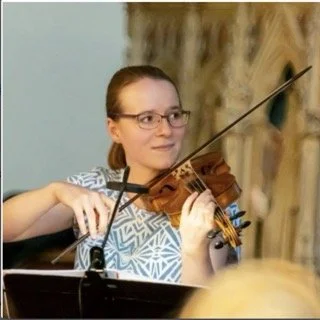


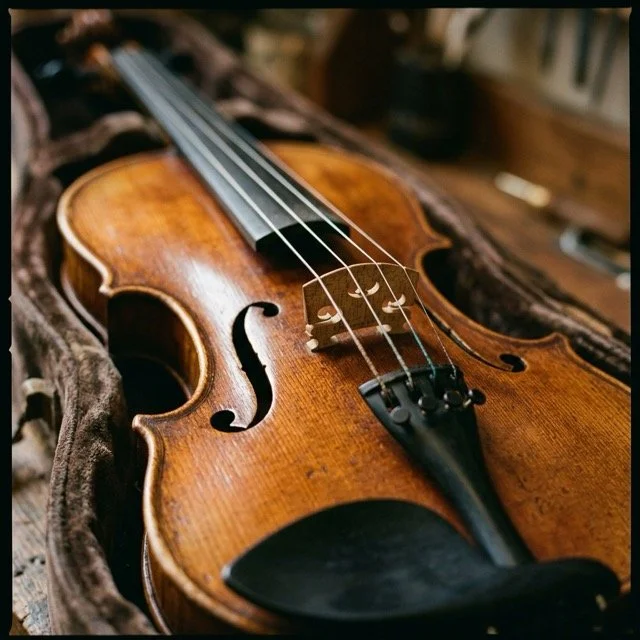
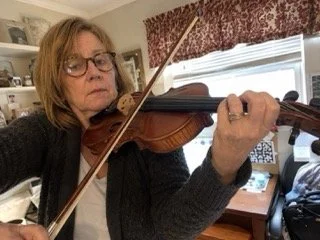
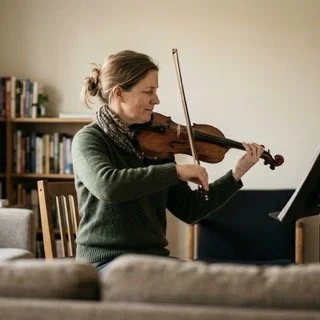
You are working one to one with a violin teacher who holds an MA in music pedagogy from the University of Music Basel / FHNW and performs internationally with major European ensembles. Fifty minutes, on your playing.
Lessons and Pricing
Before You Book
What level do I need to be?
There is no minimum. Complete beginners, returning players, advanced students, and professional colleagues all work here. The depth of the work simply adjusts to where you actually are.
Am I too old to start, or too rusty if I played years ago?
Neither is a barrier. Adults bring focus and musical understanding that young beginners do not have yet, and that shapes how quickly the instrument starts to make sense. Returning players often find that a great deal is still there, waiting to be reawakened. We begin from the player you are now, and the age you start becomes part of your particular way into the instrument rather than something to overcome.
What do I need to get started?
A violin, a stable internet connection, and a device with a camera – a laptop, tablet, or phone all work. No special software or subscription is required, and the booking confirmation includes the link. A quiet corner where you can play is enough. If you are still choosing an instrument, a short message before your first lesson is often all it takes to point you in the right direction.
Are the lessons really effective online?
Yes – this is one of the most common worries, and one of the first things students stop worrying about. The close listening that defines this kind of work is not diminished by a screen. Many students find the format works better than they expected.
Do I need a Baroque violin or period setup?
No. Most students play on a modern setup and the lessons offer the same depth either way. Historically informed performance is first a way of understanding music and sound – it is not a requirement to own particular equipment.
How does the first lesson work?
The first lesson begins with your sound and your questions. There is no intake procedure. We listen together to what is already there, identify what feels most alive and what is getting in the way, and work on something specific. You leave with at least one thing you can use immediately.
What languages do you teach in?
English and German. Either is fine, and switching between them within a lesson is equally fine. Students from anywhere in the world are welcome.
What is the cancellation policy?
Lessons can be rescheduled or cancelled without charge up to 24 hours before the start time. Cancellations with less than 24 hours' notice are charged in full. If something unexpected happens, write as soon as possible.
More questions? Read the full FAQ →
Ready to begin?
Start with one lesson. No commitment beyond that is required.
Book Your First Online Violin Lesson