
Why Online Violin Lessons Work Better Than You Think

Last reviewed: August 2026
What if the most efficient studio is the one you already live in?
Rethinking the Lesson Space
For a long time, most of us assumed that real violin lessons require being in the same room. Wooden floors, decent acoustics, a music stand that wobbles slightly. And yes – that is lovely, when it happens.
But in the last decade, online violin teaching has slowly evolved from a temporary solution into a genuinely strong learning environment. Musicians learned to use it well – and that changed everything about what online teaching can do. The question is no longer whether online lessons work; it is how they work, and where their real strengths and limits lie.
You Hear Yourself More Honestly
In an in-person lesson, the teacher's ears are always there – catching what you miss, adjusting what sounds off, filling the gaps in your own listening before you have had the chance to develop them yourself. This is generous, and it is also a crutch that takes years to notice.
Online, more of the listening tends to fall to you. Some of that is the room and some of it is the microphone, and either way you are the one who hears the note first. In practice that means you start noticing intonation problems before I point them out, feeling bow contact issues before I name them, catching the moment a phrase loses direction before it has fully escaped.
That habit is worth having in its own right, because it is what makes the practice between lessons pay.
The Focus Gets Sharper
Online lessons remove the ambient noise of getting to a lesson: the commute, the practice room corridor, the small social rituals that surround in-person teaching. Everything becomes quieter and more direct. The session starts exactly when it starts.
Through a well-set-up connection, articulation, shifts, and resonance come through clearly enough for detailed work on bow contact, phrasing, and intonation. For that kind of close listening, online is not the compromise many people expect.
The Practical Advantage Adults Never Expect
No commuting, no scrambling for rooms, no schedule gymnastics to make a lesson fit between two other obligations.
For adults returning to the violin after years away, or those balancing a demanding professional life alongside a musical one, this matters more than it sounds. The lessons that happen reliably are the ones that produce progress. A lesson that requires an hour of logistics on either side is a lesson that gradually disappears from the calendar. An online lesson opens at the time it is scheduled, from wherever you are, and closes when the work is done.
Practice becomes steadier simply because lessons become easier to attend – and that consistency is where real progress lives.
The lessons that happen reliably are the ones that produce progress.
What Online Lessons Cannot Replace
I cannot physically adjust your shoulder rest, hand you my bow, or place my hand over yours to demonstrate a bow distribution.
What I can do is demonstrate clearly on my own instrument, describe precisely what I am seeing and hearing, and guide you through the adjustment by ear and observation. For many students, this becomes a real part of the learning – because you come to understand what the correct position feels like from the inside, rather than being placed into it from the outside with no map for finding it again alone.
The absence of a teacher's hands is noticeable in the first session or two. What tends to replace it is a sense of what the position feels like from the inside, which is slower to arrive and more useful when it does, because it travels with you into the practice room and a correction placed on you from outside does not.
Who This Works Well For
The players I work with online range from returning adults who have not touched the violin in fifteen or twenty years, to working professionals who want periodic input on phrasing and style, to beginners who chose a teacher by what they wanted to learn rather than by who happened to live nearby. What they share is that they knew what kind of teaching they were looking for, and that a commute was never going to be part of it.
The listening I developed performing with period ensembles, where every articulation is intentional and every phrase has to carry across an acoustic space, is what I bring to an online session. A screen does not change what I hear.
If the practical case makes sense and the remaining doubt is whether it can be real teaching, one session answers that faster than another article can.
One lesson is enough to find out.
We begin exactly where you are, with your violin and whatever question brought you here. You leave with one thing you can use the same day, and nothing beyond the first lesson is asked of you.
Book Your First Online Violin LessonBefore you book
Can a teacher really hear my violin well online?
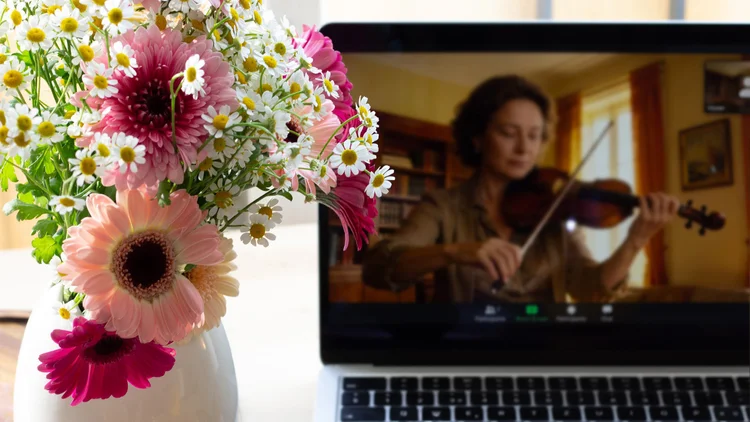
Yes. With Zoom and a standard laptop microphone, intonation, bow contact, and articulation all come through clearly enough for precise, real-time feedback. I have taught entirely online for years and find the environment consistently strong for detailed work.
What if my internet connection is unstable?
We troubleshoot together. Mild interruptions are an inconvenience, not a crisis – and they happen far less than people fear. If a session is genuinely unworkable, we reschedule at no cost.
Do I need a special microphone or camera?
Not for a first session. A laptop microphone and built-in camera are completely fine to start. An external microphone improves the experience over time but is never urgent.
Are online violin lessons suitable for complete beginners?
Yes. What a beginner needs most in the early months is somebody watching how the instrument is held and how the bow travels, and a well-placed camera shows both. The part that takes more care online is sound quality, so a beginner who wants detailed work on tone should expect to want a better microphone sooner than a laptop provides.
How do online violin lessons compare to in-person lessons?
They are different. Online lessons sharpen your own listening, because more of it falls to you, and they fit adult life more reliably. What is lost is physical adjustment and playing together in real time, since ordinary video calls carry too much delay for two people to share one pulse. For observing playing, testing changes and deciding what to practise next, the difference is smaller than most people expect.
Continue reading
© 2026 Léna Ruisz. Text and images may not be reproduced without permission.