
Mindful Practice for the Modern Violinist
Last reviewed: August 2026
How little can you do… and still improve?
Practising with Awareness
At some point most of us have practised like we were putting in time rather than doing anything with it. The bow moves, the passage repeats, the session ends. Something happened, but nothing changed.
Mindful violin practice for adults means becoming genuinely awake to what is actually happening under the bow, in the phrase, between intention and sound. How to practice violin effectively turns out to have less to do with how long you spend and more to do with how honestly you listen while you are there.
This is not a new idea. Teachers have been saying some version of it for as long as there have been teachers, which is worth knowing mainly because it means the difficulty is not personal.
Listening Instead of Fixing
When something does not work, the instinct is to fix it immediately. Shift faster, press harder, try the passage again with more determination. But determination applied to the wrong problem is just repetition with added anxiety.
Determination applied to the wrong problem is just repetition with added anxiety.
Before the fix, there is a more useful step. Listen. Not to the general impression of whether it is going well or badly – listen to what is specifically, actually there. What is the bow arm doing at the start of that note? Where exactly does the intonation drift? What happens to the sound when the phrase turns?
Once you start noticing what is truly there, the correction often suggests itself. That shift – from fixing to listening – is harder to make alone than it sounds, because the habit of anxious repetition is strong and an external ear changes the quality of attention in the room immediately.
The Sound of Breathing
Musicians have described music as a form of speech for centuries, with rhythm, punctuation and breath. That is a useful description whatever you play, because it gives the bow arm something to think about other than producing sound evenly.
Try this: take one easy breath before a phrase. Let the bow begin to move with the exhale, and notice what changes. The sound often opens – less controlled, more present. The breath releases the shoulder, the shoulder releases the arm, and the arm releases the bow. One breath, four consequences.
The exercise is simple enough to try today. What it reveals is usually less simple, because a change in the sound can come from the shoulder, the bow speed, the contact point or the phrase itself, and telling those apart is its own skill.
When Attention Runs Out Before the Time Does
Something changes after a stretch of continuous playing, and it rarely announces itself as tiredness. Intonation that was easy twenty minutes ago starts to need deliberate effort. A shift that was fluid becomes approximate. From inside, that feels like a technical problem arriving out of nowhere.
In my teaching, the players who make the most of a short evening are the ones who break it up. Two or three blocks with a real gap between them, instrument down and standing up, tend to leave more behind than one unbroken stretch of the same total length. Treat that as something to test on your own playing rather than as a law. The test is easy, because you keep the total time the same for a fortnight and change only the shape of it.
Violin Practice Awareness: The Details That Change Everything
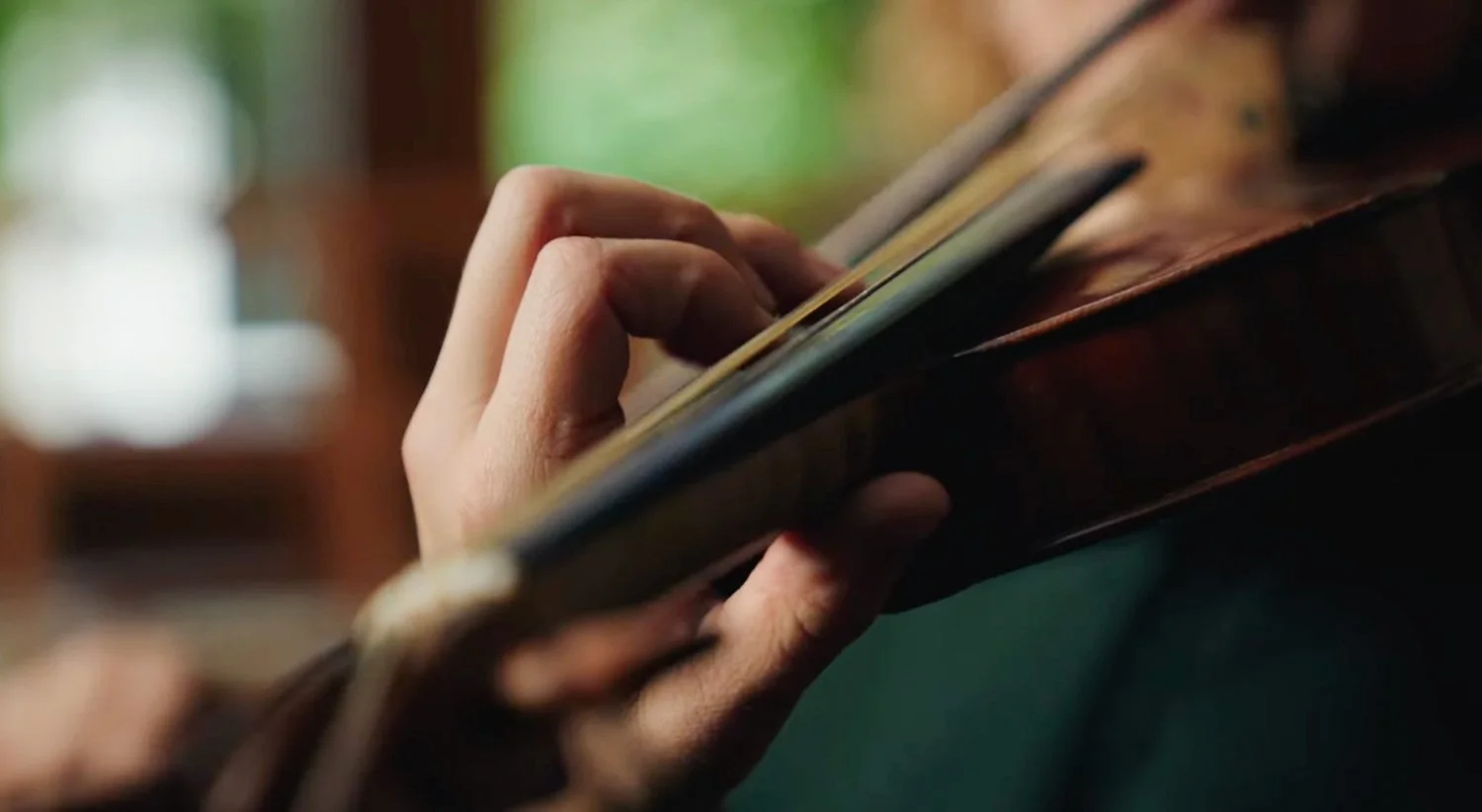
Mindful practice means paying attention to the moments that usually get skipped: how does the bow land on the string? How does the note end? What happens in the body between the intention and the sound?
Change one small thing on purpose and the violin answers differently. Touch, weight, where the hair sits between bridge and fingerboard, the balance of the bow at the tip. Any of them will do, because the point is the noticing rather than the variable itself.
What I notice again and again with adult learners is that progress has little to do with how much someone practises. It has everything to do with curiosity – the willingness to sit with a single phrase, a single bow change, a single moment of tension in the left hand, and stay interested in it long enough to understand it.
From Practice To Presence
The simplicity of this approach is what I keep coming back to. Before you try to fix something, notice it. Before you repeat a passage, listen to what the previous repetition actually produced. Before you add more, ask whether less might serve better.
More sound with less strain. More confidence with less overthinking. A practice routine that feels more like genuine exploration than managed endurance. And occasionally – not always, but often enough to keep you coming back – the violin begins to cooperate.
Noticing is trainable, and it is trainable alone. The part that stays hard is the step after it, when you can hear that something changed and cannot yet say which change mattered. That is a separate skill, and it is the one worth building next.
Begin with one lesson.
A full working lesson – we begin with the piece you already know, and the questions honest listening raises about it. You leave with something you can use the same day. No commitment beyond that is required.
Book Your First Online Violin LessonBefore you book
How much time do I need to practice mindfully each day?
20–30 focused minutes is more than enough – and more productive than an unfocused hour. The quality of attention matters far more than the duration. We design a realistic practice rhythm together.
What is the difference between mindful practice and just playing slowly?
Slow practice without awareness is still autopilot – just slower. Mindful practice means actively noticing: what is the bow arm actually doing? Where does the phrase want to go? What changes when I release rather than press? Speed is irrelevant; observation is everything.
Can mindful practice replace technical exercises?
It transforms them. Scales and études become genuine practice rather than warm-up ritual when approached with full attention. Many students find they need fewer exercises once they apply real awareness to the ones they already do.
How do I know whether my practice is actually working?
Check whether you can say what changed between two repetitions. If you can name it, the loop is working and repetition will pay. If every attempt blurs into the same general impression of better or worse, more repetition mostly buys you more of the same. Recording one take and rating it before you listen back is the quickest way to find out which of those you are doing.
I tend to zone out when I practice. How do I stay present?
By working with smaller units. Instead of running through a whole piece, take one phrase and give it your full attention for five minutes. Ask: what is this phrase doing? Where is it going? Presence comes from having a specific question – not from trying harder to concentrate.
Continue reading
© 2026 Léna Ruisz. Text and images may not be reproduced without permission.