
Rediscovering the Violin in Adulthood: A Journey of Sound, Sensitivity, and Self
Last reviewed: August 2026
Can the violin become a place… to come home to?
The Violin Did Not Forget You
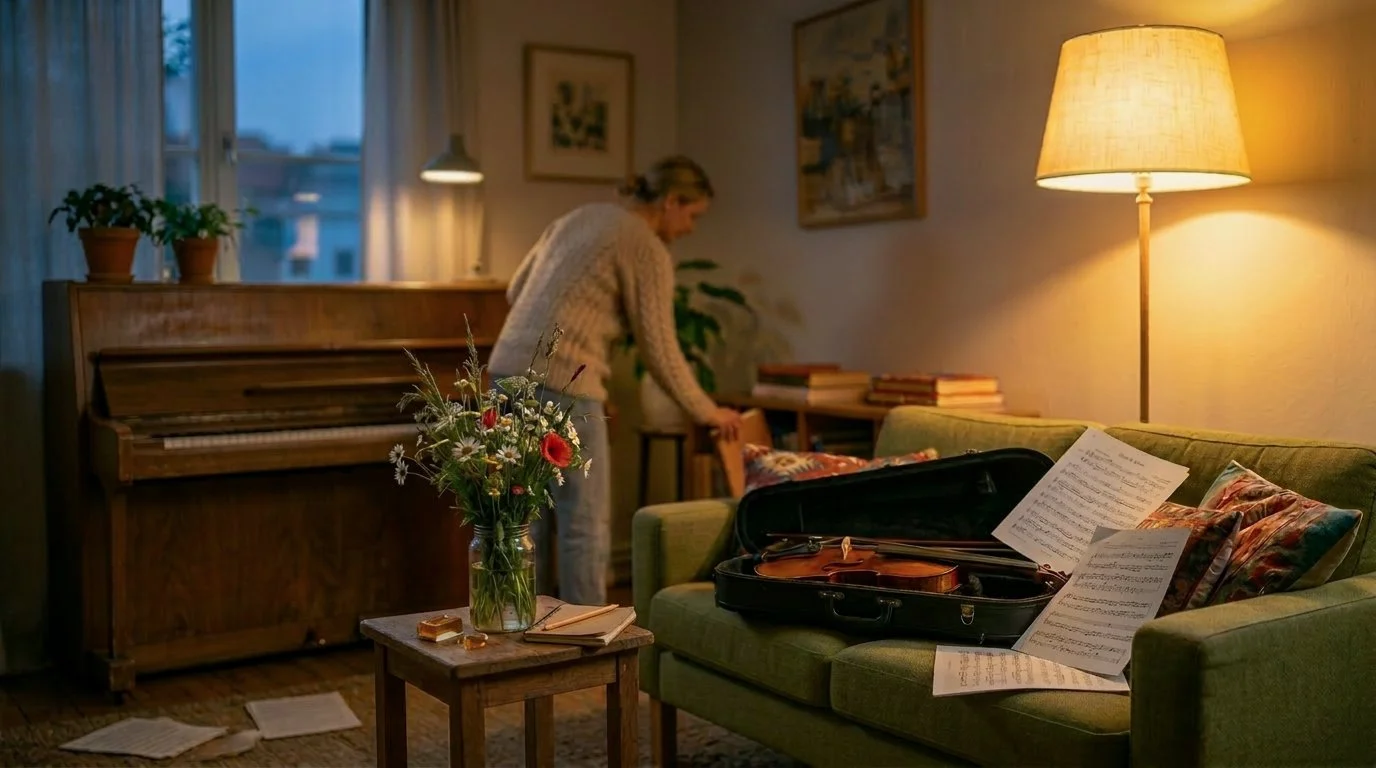
Most of the adults who write to me open with some version of the same sentence. "I used to play – and then life happened." Sometimes it was university, sometimes a move, a job, a child, a decade that passed faster than expected. The instrument went into a case, the case went into a wardrobe, and at some point the wardrobe stopped being opened.
What surprises people, when they finally come back, is what stayed.
The muscle memory is patchier than expected – shifts feel uncertain, the bow arm has opinions of its own. But the musicianship is almost always intact. The ear that knows when something is off, the sense of phrase, of when a line breathes and when it does not. The feeling for what the music is trying to say. None of that evaporated; it was just waiting.
Returning to the violin as an adult is not starting over. It is starting from somewhere – with years of listening, of living with music even from a distance, of understanding things now that were simply beyond reach at fifteen.
Returning to the violin as an adult is not starting over. It is starting from somewhere.
What the Body Remembers
The first few weeks back are often the most disorienting, and it is worth naming this honestly so it does not come as a surprise.
The left hand remembers more than you expect. Finger patterns from pieces you played twenty years ago can return almost intact, arriving before the conscious mind has had time to recall them. The bow arm, on the other hand, tends to be more sceptical. It has spent years doing other things, and it takes a few sessions to convince it that this old movement is worth re-engaging.
There is something that the research on motor learning calls consolidation – the way physical skills, once genuinely learned, leave traces in the nervous system that are surprisingly durable. A returning adult violinist is not building from zero. They are reactivating a network that already exists, which is a fundamentally different task from learning for the first time. Progress, when it comes, tends to arrive in larger steps than beginners experience, precisely because so much of the underlying structure is still in place.
What this means practically is that the first few lessons are not about rebuilding from scratch. They are about finding out what is already there – and deciding, together, what to do with it.
The Gift of Perspective
Adults bring something to music that is genuinely impossible to fake: experience.
You have listened to music for decades. You have a relationship with certain pieces, certain composers, certain sounds that is entirely your own – built from concerts, recordings, memories, the particular way a phrase struck you at a specific moment in your life. That is not irrelevant background; it is musical capital.
When you return to the violin, you are not starting over. You are refining perception. Each note becomes an observation, each phrase a dialogue between instinct and awareness – between what you know and what you are learning to hear again.
That refining is the real work of a return, and it can take any direction you like. Some players go towards chamber music, some towards folk or improvisation, some back to the repertoire they loved at seventeen and can now hear properly. Some become curious about where a phrase came from and what it was written to do, which is one of several places that curiosity leads. Whichever it is, the choice belongs to you now, and that is new.
Starting Again – Without Starting From Zero
The question I hear most often is some version of: where do we actually begin?
The answer depends on the person. Some returning adults need a few sessions of purely physical recalibration – finding the bow hold again, getting comfortable with the weight of the instrument, letting the shoulder settle. Others arrive technically functional but musically disconnected; they can play the notes but cannot yet feel the music behind them. Others are technically and musically present and want a direction to point all of it at, which might be a piece, an ensemble, a sound they have been chasing, or a question about the music itself.
In online lessons, we begin wherever you actually are – not where you think you should be, and not at some assumed starting point. The first session is a conversation and an observation. I listen, I watch, and then I choose one or two things to work on. Never a list of faults. Always a direction.
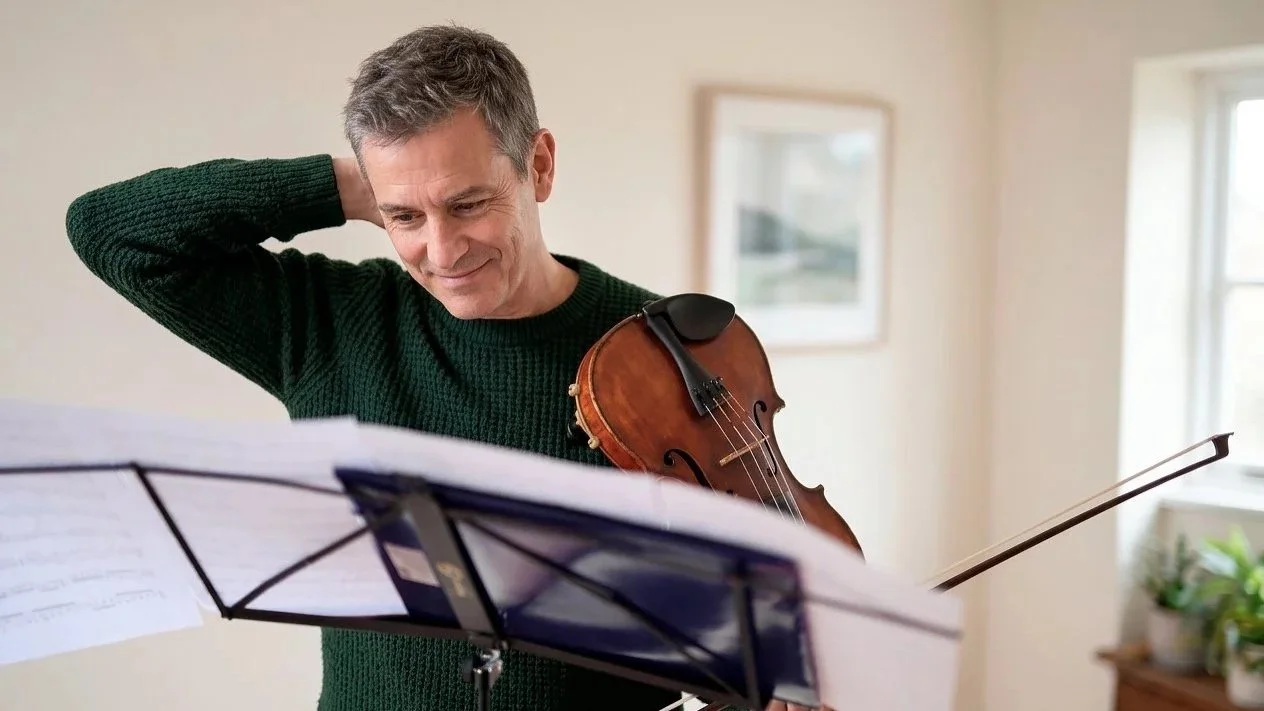
One of my adult learners – a retired surgeon who had played seriously as a young man and returned in his late fifties – described his first few months back as learning to trust his own ear again. The technique came back quickly. What took longer was giving himself permission to form opinions: about phrasing, about sound, about what he actually wanted the music to do. That permission, once given, transformed everything.
Finding Your Voice Again
There is something that happens, usually quietly, a few months into a return. The violin stops feeling like an obligation or an experiment and starts feeling like a conversation partner again.
The sound becomes more personal. You start making choices – this phrase slightly slower, this one with more bow, this ornament here because it feels right – and you notice that the choices come from somewhere genuine rather than from instruction or habit. That is the moment when playing becomes yours again.
What makes those choices possible is having reasons for them, and reasons are something adults are unusually good at building. You have opinions about music already. The work of a return is largely the work of connecting them to your own hands, so that a phrase goes the way it does because you decided it should. Playing in order to move somebody, yourself included, is a goal worth returning to the violin for, and it requires nobody's permission.
The violin does not care when you start. It only cares how you listen.
Begin with one lesson.
A full working lesson – we begin with whatever is still there, and find out together what to do with it. You leave with something you can use the same day. No commitment beyond that is required.
Book Your First Online Violin LessonBefore you book
How long does it take to feel comfortable again after a long break?
Most returning adults feel physically comfortable within a few weeks of regular practice. Trusting your musical instincts again usually takes a few months – and it comes faster with guidance than alone, because you stop second-guessing everything you do.
Should I restart from basics or pick up where I left off?
Neither exactly. We start from where you are now – which is not where you were at seventeen, and not zero. The goal is to find what has stayed and build a sustainable path forward from that foundation.
What repertoire is realistic for a returning adult?
Whatever you love, matched to what your hands can currently do. Returning players often find that music which rewards listening and phrasing gives more back than music that mainly rewards speed, and that is true across a great deal of the repertoire rather than of one period. We choose it together, from your taste, your level and the playing you have now.
I am in my fifties or sixties – is it too late to make real progress?
Not at all. Many of my most rewarding students are in this age group. Adults in their fifties and sixties bring patience, musicianship, and genuine curiosity that accelerate progress in ways younger students simply cannot access yet.
Will you judge my playing after years away from the violin?
Never. The first session is a conversation, not an audition. I am not there to assess how "good" you are – I am there to understand how you think and what you need. Playing in front of me after years away is never something to prepare for.
Continue reading
© 2026 Léna Ruisz. Text and images may not be reproduced without permission.