
Useful Sources for Self-Studying the Baroque Violin

Last reviewed: August 2026
The eighteenth century wrote everything down – so why is reading it not enough?
Testimony, Not a Rulebook
The most reliable advice about Baroque violin playing was written in the eighteenth century, and none of it has been superseded. What the great pedagogues of that era left behind is often mistaken for a rulebook, and it is nothing of the kind. It is testimony – a record of how thinking musicians described sound, phrasing, and expression to one another, at a moment when those things were argued over rather than settled.
And they were argued over. Geminiani, Leopold Mozart, and Tartini disagree with one another on bow hold, on vibrato, on the rule of the down-bow. They were not transcribing a single truth. They were arguing, in print, about what good playing required – and a reader who understands that immediately understands something more useful: reading the sources alone tends to produce confusion before it produces clarity.
This matters because access is no longer the difficulty. Every one of these treatises is a free download, the scans sitting on public archives, waiting. What is scarce is not the document but the reading of it – someone who has spent years inside the arguments and can tell you which voice applies to the phrase in front of you today, and which one to set aside. For Historically Informed Performance, these texts are not background reading. They are the primary material, and primary material has to be interpreted before it can be used. That is what this guide is for: not a reading list to work through alone, but a map of the sources and an honest account of where self-study runs out and a second ear begins.
The Primary Voices
Six voices form the backbone of any serious self-study, and the useful thing to know about each is not only what it offers but where it becomes difficult.
Francesco Geminiani published The Art of Playing on the Violin in London in 1751, and it remains the cornerstone of expressive bowing and ornamentation, as well as the most immediately practical of the major sources. His instructions are specific enough to take straight to the instrument, which is rarer than it sounds. What strikes me every time I return to him is how fiercely he insists on variety: of bow pressure, of vibrato, of articulation. The monotony he warns against is precisely the default that modern string training tends to produce, because consistency is taught as a virtue. Geminiani treats it as a failure of imagination. His left-hand exercises, which arrive almost as an afterthought in the text, are among the most useful I have found anywhere.
Leopold Mozart's Versuch einer gründlichen Violinschule, published in Augsburg in 1756, is an entire worldview set down in staff lines and barely concealed sarcasm. He is the most opinionated of the sources and therefore the most entertaining – he has no patience for players who do not think, and he says so on almost every page. His chapter on expression is where I send students first, because it makes the link between rhetoric and bowing explicit in a way no modern method quite manages. The footnotes reward as much attention as the main text, and his mockery of the players he calls Luftviolinisten describes a habit that has not gone anywhere in two and a half centuries.
Giuseppe Tartini's Trattato di musica secondo la vera scienza dell'armonia, published in Padua in 1754, is the most demanding of the main sources and the most rewarding for players with a scientific turn of mind. His work on difference tones – the faint third tone that sounds when two notes are played together – has direct consequences for intonation and bow pressure that most players never meet until they begin working with gut strings and lower tension. His approach to tone production differs fundamentally from what modern pedagogy teaches, and the difference is audible.
Johann Joachim Quantz wrote his Versuch einer Anweisung die Flöte traversiere zu spielen in Berlin in 1752 for flautists, and it is indispensable for violinists. His chapters on taste, on tempo, and on the relationship between gesture and musical character are among the clearest writing on performance practice from the entire period. What he says about shaping a phrase – where the weight falls, how a cadence speaks, what a silence is for – transfers directly to the bow arm. I return to him whenever I need reminding what the period sources actually prioritised.
C. P. E. Bach's Versuch über die wahre Art das Clavier zu spielen, published in Berlin in 1753, is a keyboard treatise and also a masterclass in emotional timing – in what Bach calls Empfindung, feeling. His account of how a performer must feel the affect of a piece before playing it, and how that feeling shapes every small decision of articulation and dynamics, speaks directly to any string player working in this repertoire.
Michel Corrette's L'art de se perfectionner dans le violon, published in Paris in 1782, is the most compact and readable of the major sources. He writes plainly and practically, and his Classical-era French perspective is a useful counterweight to the German voices. For anyone who finds the other treatises overwhelming, Corrette is the gentlest way in.
The sources themselves rarely agree, and that is precisely why they reward reading. The disagreements are where the interesting questions live.
The disagreements are where the interesting questions live.
The Gap Between the Page and the Instrument
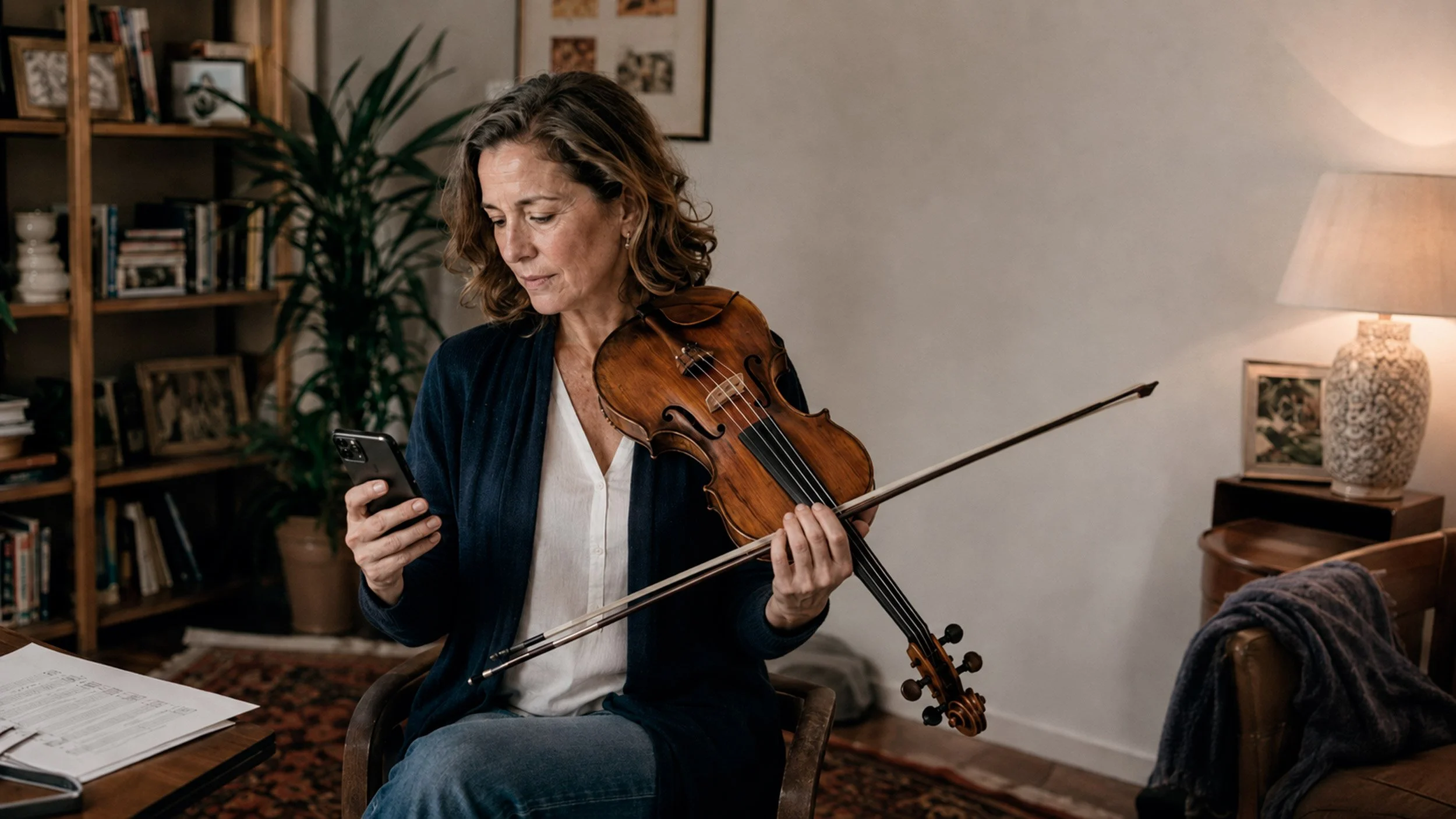
There is a second difficulty that reading alone cannot solve, and it is easy to miss. The treatises describe a violin that is not the one in your case. Geminiani's left-hand exercises were written for a collarbone hold with no chin rest, in a pitch world that no longer exists, for a bow whose balance behaves nothing like the one you are holding. None of that makes his advice wrong. It makes it a text in a foreign dialect, fluent in assumptions that were obvious in 1751 and invisible now.
So every sentence needs translating before it touches your playing, and translation is a skill rather than a lookup. Reading that Geminiani wants more variety of bow pressure is simple. Knowing which of your down-bows is flattening the phrase this morning, and what to change so the line breathes, is another matter entirely. The instruction sits on the page in general terms; your playing happens in particular ones. Closing that distance is the actual work, and it is the part self-study leaves undone. It is also the clearest case there is for a second opinion, since the problem stopped being access to information some time ago.
Listening as Reading
The treatises describe a sound world you need to hear before you can fully understand what they are prescribing. Reading Geminiani on bowing variety is one thing; hearing what that variety sounds like in the hands of a musician who has absorbed it is another entirely, and the second is what makes the first legible.
Listen to Amandine Beyer, Enrico Onofri, Rachel Podger, or Monica Huggett, and notice how the phrases breathe, how the cadences speak, how the rests carry weight rather than merely interrupting. Follow a score alongside the recording if you can. What you are hearing is not simply a performance style. It is the treatises in sound.
The link between what you read and what you hear does not form on its own. It takes time, and it takes guidance from someone who has already made it. This is the gap self-study cannot close by itself: you can read Geminiani and listen to Beyer for a year and still not know which bow movement to change on Tuesday morning to make your Corelli phrase breathe the way hers does.
Reading With Restraint
The single most useful thing I can tell you about working with historical sources is to do less of it at once. Choose one treatise, one recording, and one piece of music, and live with the three of them together for a while. Read a few lines, take the idea straight to the instrument, and notice what changes. Put the book down the moment the violin starts answering.
The mistake most players make is reading a great deal before trying anything. The treatises were written for working musicians, not scholars; they are practical manuals meant to be experimented with, and they respond badly to being absorbed passively. A single afternoon spent with Geminiani's remarks on bow pressure and an open A string will teach you more than a week of reading in an armchair.
And this is where the sources stop being homework and become the best part of the lesson. Picture the piece you are learning open on the stand, one page of Leopold Mozart open beside it, and the two of us reading the same sentence and then playing the phrase it describes – trying it his way, then another way, then finding the German words whose weight matches the line. That is not preparation for a lesson. That is the lesson, and it is one of the real pleasures of this work. The sources become companions rather than instructions, and the practice room becomes the place where the eighteenth century and your own musical intelligence meet.
What the Sources Give You
Spending real time inside these treatises changes how you hear music – not only Baroque music, but all of it. The questions they train you to ask – where is the weight in this phrase, what does this silence want, how does this harmony change the character of the note – do not stop being useful when the repertoire changes. Students who read the sources regularly describe a shift in their listening that reaches into Brahms, into Romantic concertos, into music that has nothing historically in common with Geminiani's world. The habit of asking the right question turns out to be more durable than any single answer.
That, in the end, is what self-study in this tradition is for. The point is a quality of musical intelligence that keeps asking long after the treatises are back on the shelf, rather than an accumulation of knowledge about the Baroque. The sources are excellent teachers. They simply work best with someone listening alongside you.
We begin with one source, one phrase, and whatever brought you here.
Begin with one lesson.
A full working lesson – we begin with one source, one phrase, and the piece in front of you, and you leave with something you can use the same day. No commitment beyond that is required.
Book Your First Online Violin LessonBefore you book
Do I need to read the treatises in their original language?
No. Reliable translations exist for all the major sources. Leopold Mozart is available in English as A Treatise on the Fundamental Principles of Violin Playing, translated by Editha Knocker; Quantz as On Playing the Flute, translated by Edward Reilly. Geminiani wrote in English to begin with. Translations of Tartini and Corrette exist too, though some are harder to track down.
Where do I start if I have never read a historical treatise before?
Geminiani first – his instructions are concrete enough to try at once on the instrument, which keeps the reading productive rather than abstract. If you find him dense, Corrette is the most accessible way in. Leopold Mozart is the most entertaining, but his strong opinions land better once you have a little context.
Are these sources relevant if I play a modern instrument?
Entirely. The treatises deal with phrasing, articulation, affect, and musical character, none of which depends on a historical instrument. What changes on a modern setup is how you carry the ideas out physically – which is exactly where a guide who has worked with both setups earns their place.
How do I use a treatise practically rather than just reading it?
Read one short passage, then go straight to the instrument and try it – and put the book down before you pick up the bow. The treatises were written for working musicians, not scholars, and they respond to that treatment. A single afternoon with one idea will teach you more than a week of reading without playing.
Can I work through these sources in online lessons with you?
Yes, and it is one of the things I most enjoy doing together. Alone, you cannot always tell whether what you are hearing in your own playing matches what the source is actually describing. A second ear in the room makes the translation from text to sound considerably faster.
Continue reading
© 2026 Léna Ruisz. Text and images may not be reproduced without permission.