
Holding The Violin With (Or Without) A Chin Rest
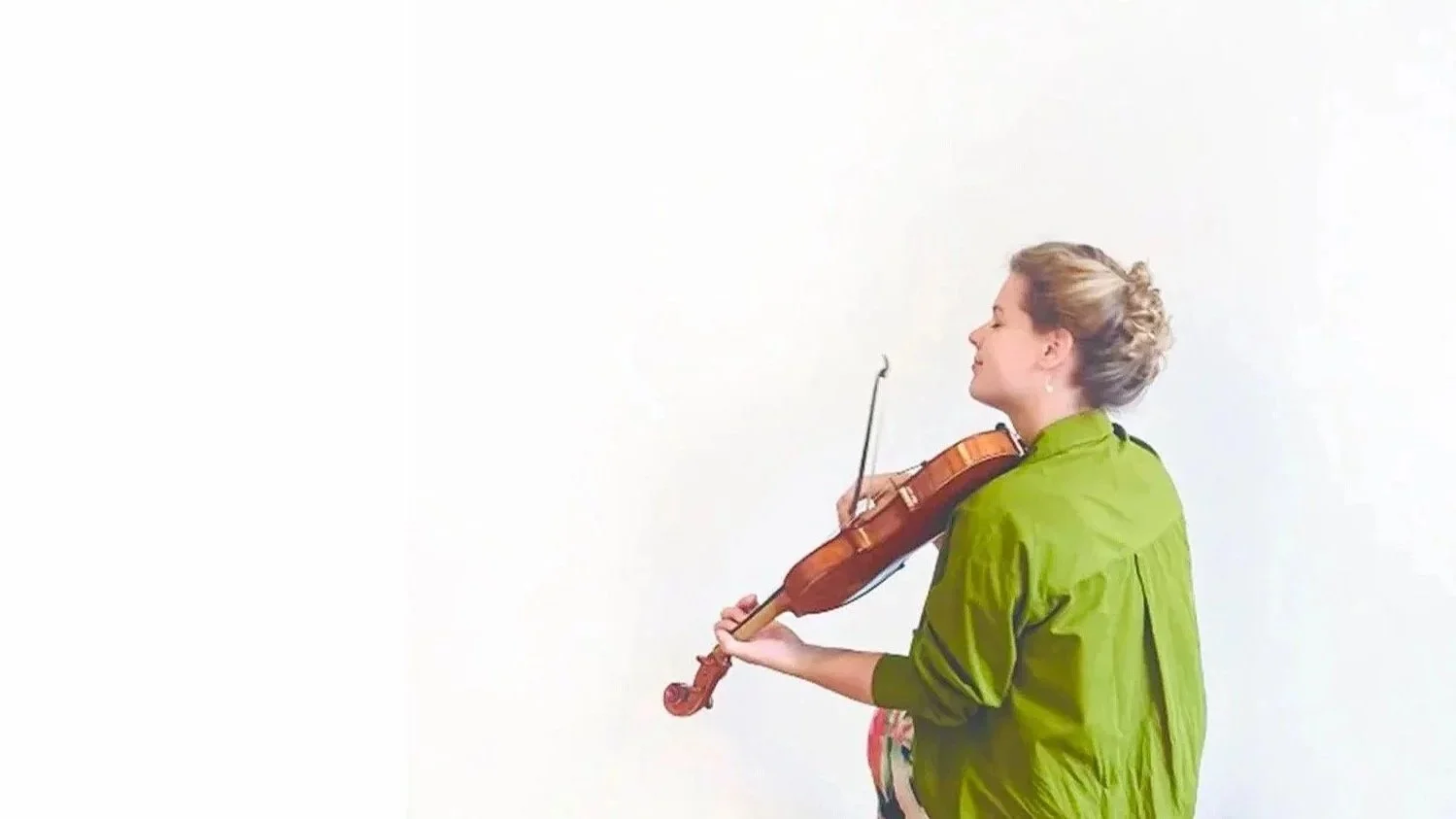
How much freedom can your body actually use? (This is a slightly longer read – feel free to bring tea.)
A Violin That Kept Moving
My own Baroque story started when I was sixteen, at a summer course in a castle hidden in the Hungarian countryside.
I arrived as a perfectly normal modern violin student: scales, études, a familiar shoulder rest, a violin held safely on the collarbone. I could shift, vibrate, and play in tune. I knew where the instrument “lived” on my body. Then my Baroque teacher handed me a different violin, a different bow, and said, with disarming cheerfulness:
“Try playing without the chin.”
Everything changed.
The balance, the angle, the weight, my sense of security – suddenly even first position felt uncertain. It was mildly humiliating and strangely exciting at the same time. That shock, in retrospect, was incredibly useful. It reminded me that nothing about our setup is guaranteed. It is learned. Which also means it can be relearned.
From there I made a slightly nerdy decision: to follow the violin’s development chronologically – instrument, bow, tuning, posture, repertoire – and see how each stage shapes the way we think about interpretation. That journey is the reason I feel strongly about chin-off today.
Following the Violin Through Time
In Vienna I began at the “beginning”: low hold, the violin resting under the collarbone, a clip-in frog bow, the thumb not squeezed up against the frog but a little underneath it (the so-called Unterhaltung). The repertoire matched – early sonatas, dances, the first music that really belongs to the violin.
Over time, as I moved forward historically, the instrument crept upward. I experimented with holding the violin just above the collarbone, playing with and without any support, and doing frankly heroic amounts of exercises to find balance without gripping.
One book became a quiet anchor: Francesco Geminiani’s The Art of Playing on the Violin (1751). Hidden in his clear, slightly strict prose are some of the most practical exercises for chin-off stability you can find. If you want to understand this technique rather than simply survive it, Geminiani is a good friend to have on the stand.
And historically, he had no other option. The chin rest only appears in the early 19th century, usually credited to Louis Spohr, around 1820. For Bach, Corelli, Tartini and their colleagues, playing without a chin rest was not a brave artistic choice – it was simply reality.
Why Chin-Off Belongs In The Toolbox
For me, chin-off playing is not an aesthetic statement. It is a skill – one of the tools you should have if you say you play Baroque violin or work within Historically Informed Performance (HIP).
Because it teaches:
balance instead of gripping
phrasing that grows from the bow, not from clamping the neck
how the left hand can release instead of hold on for dear life
If you only ever play with a high chin rest and shoulder rest, it is easy to forget how much quiet work they do for you. Removing them – at least in the practice room – reveals which movements are truly yours and which are simply supported by hardware.
That can be uncomfortable at first. It is also very honest.
When Practicality Matters More Than Dogma
Now for the other side of the story.
I do not live exclusively in the world of early Corelli and friends. I play in a variety of historically informed orchestras, including those that focus on later repertoire – Beethoven, Schubert, Schumann – with all the demands that come with that: long rehearsals, thick textures, high tessitura, and plenty of sweat.
In those contexts, absolute purity of setup is less important to me than being able to play well and stay healthy.
So I made a practical choice: for later repertoire I use a tiny, very low chin rest, placed centrally on the violin. No shoulder rest, no sponge, no cloth – just a discreet support, maybe one and a half centimetres high, that stops the instrument from sliding away when things get athletic.
The irony is that I still play almost completely chin-off. The chin rest is there as a safety rail, not a throne.
This is why I resist the idea that chin-off vs chin rest is a moral question. It isn’t. It is a question of repertoire, body, and context. What matters is that you understand the chin-off technique and can use it when it serves the music – not that you pass a purity test.
What Changes When You Remove The Chin Rest
When you first try chin-off, several things happen at once:
Your left hand suddenly realises how much it was helping to hold the instrument.
Shifts feel exposed – because they are.
Vibrato becomes less of a permanent background and more of a conscious choice.
The bow has more responsibility for shaping the phrase.
This can feel terrifying. It can also be incredibly freeing.
Without a fixed clamp between jaw and collarbone, the violin is allowed to move slightly with the body. The instrument becomes part of your posture, not an object you pin in place. For Baroque and early Classical repertoire – music built on speech, gesture, and flexibility – this mobility is often a gift.
The key is to approach it gradually and curiously, not as a heroic all-or-nothing leap.
Learning Chin-Off Safely
If you want to explore this, a few gentle principles help:
Begin in first position with simple material – scales, open strings, slow phrases. (I am terribly sorry, but Henry Schradieck’s School of Violin Technics works great…)
Check your breathing. If your shoulders are up by your ears, something is trying too hard.
Let the thumb and collarbone share the work. Neither should be gripping alone.
Notice where tension appears. Jaw? Neck? Left thumb? That is where you need less “help,” not more.
Chin-off is not about proving how brave you are. It is about discovering how little you actually need to hold in order to play clearly and expressively.
HIP, History, And The Chin Rest
From a HIP perspective, it helps to remember the timeline:
Baroque and much Classical repertoire were written for chin-off players.
The chin rest appears only in the early 19th century, about the time of Spohr and his generation.
It spreads because repertoire becomes more acrobatic and left-hand freedom increasingly important.
So when we explore chin-off today, we are not reenacting something exotic. We are briefly stepping back into the default world for several centuries of music – and then deciding, with modern knowledge, what to keep and what to adapt.
Historically Informed Performance, at its best, invites exactly this kind of flexibility: understanding where a practice comes from, and then choosing how it serves your sound, your body, and your repertoire.
Flexibility Instead Of Judgment
The chin rest is a relatively new invention in violin history. The arguments around it, however, sometimes sound ancient.
My own position is simple:
Yes, chin-off is essential to learn if you are serious about Baroque violin and HIP.
No, it does not mean you must reject every form of support in every context.
Early musicians adapted constantly – to pitches, halls, instruments, and circumstances. We can allow ourselves the same generosity.
If a tiny, low chin rest helps you play Beethoven on gut strings without injuring your neck, that is not a betrayal. It is a sane decision made by a listening, thinking musician who understands the options.
How This Plays Out In Lessons
In my online lessons, we treat chin-off not as a badge of honour, but as:
a skill to be learned step by step
a tool for certain repertoires and articulations
a mirror that reveals how you balance, breathe, and use tension
With some students we experiment briefly and return to a more supported setup. With others we gradually shift toward more historical holding. With professionals we often design a hybrid solution tailored to their repertoire and body.
The goal is always the same: more freedom, less fear, and a setup that helps you play the music you love – not one that wins ideological arguments.
If you are curious about exploring chin-off – or finding a setup that feels both historically aware and physically sustainable – I would be happy to work with you. We start from your current instrument, your repertoire, and your body, and build options from there.
More threads to follow ・・・
Inside the Studio – How I Teach, Think, and Listen│My longer “behind the scenes” manifesto about sound, history, and teaching.
Bringing HIP Awareness to Modern Violin Playing │ How historically informed ideas on sound, phrasing, and setup can deepen your modern playing without asking you to change your musical identity.
Mindful Practice for the Modern Violinist │ Bringing awareness, breath, and clarity into your daily practice so technical work and musical meaning actually support one another.
☯︎
© 2026 Léna Ruisz. Text and images may not be reproduced without permission.