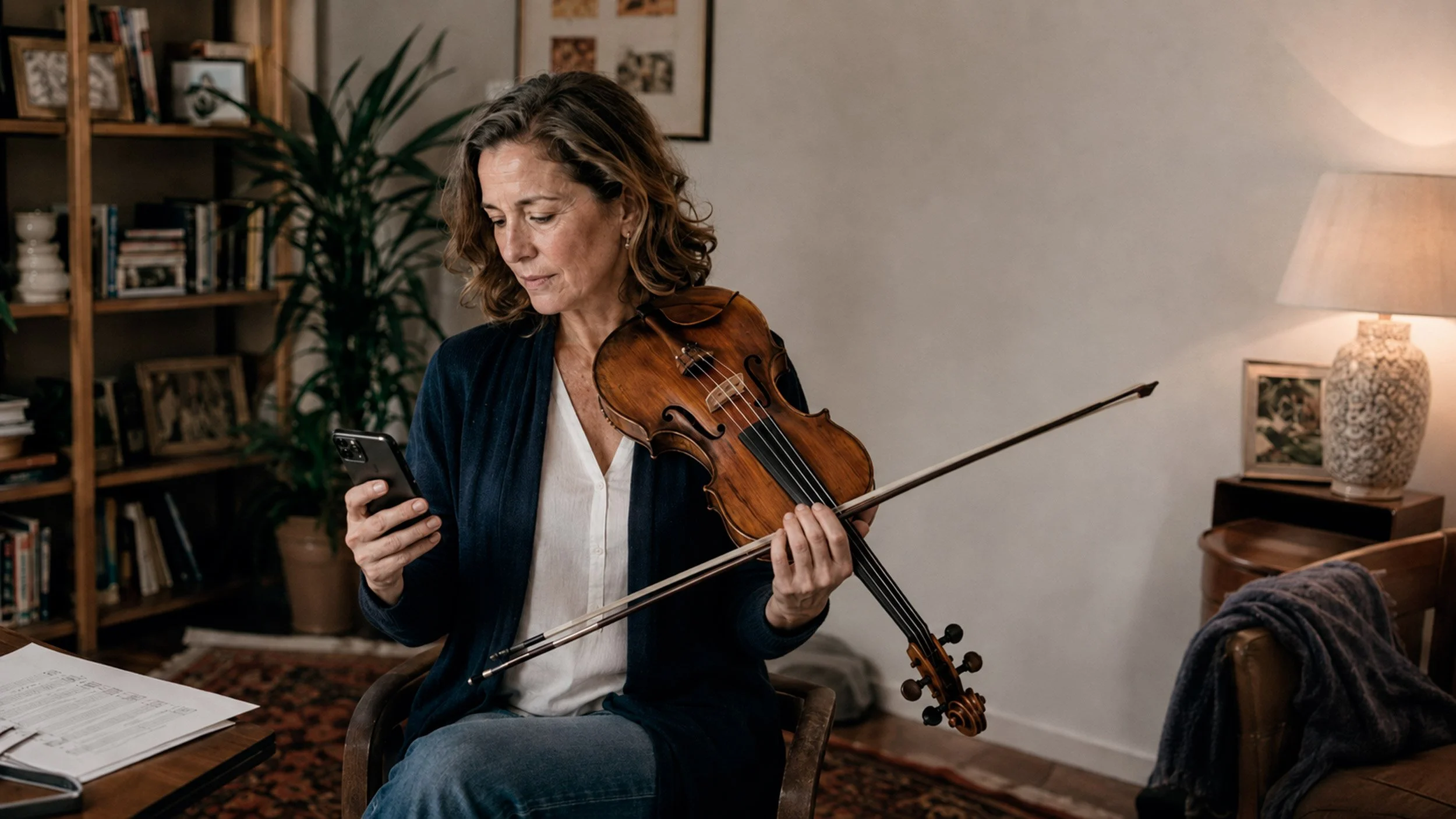
The Musician You Become When No One Is Grading You Anymore
Last reviewed: August 2026
What happens when music becomes yours again?
A Different Kind of Beginning
There is a moment many musicians recognise: the long-awaited realisation that no one is grading you anymore. No jury, no anxious comparison to the nine-year-old prodigy who plays Paganini 24 for breakfast. And with that pressure gone, something shifts.
The violin starts to feel like something that belongs to you rather than something you are being assessed on. Adult learners come back to the violin knowing things they did not know the first time – about music, about themselves, about what they actually want from the instrument. That knowledge changes everything about how you learn.
When Curiosity Takes Over
One of my favourite things about teaching adults is that curiosity becomes the primary engine of progress. No one is memorising scales for a theoretical exam or rushing through études to please a teacher. Instead, real questions arise:
How does the harmony change the weight of a note? What happens if I treat this slur as a spoken gesture? Why does this passage sound better at eleven at night than it did at six? Is this fingering the one I want, or the one somebody printed?
That kind of questioning is what turns a player into a musician, and it does not arrive on any syllabus.
Curiosity of that kind can go in any direction. Some players follow it into chamber music, some into improvisation, some into one composer for a year. Some follow it backwards, into what the people who wrote this music said about playing it, which is one route among several and happens to be mine.
Taste Without Comparison (finally)
When you are no longer trying to prove anything, taste finally has room to grow.
You start developing opinions – not because someone assigned them, but because you begin to hear differently. You notice tone colours you did not notice before. You recognise phrasing that feels natural versus phrasing that feels performed. You start shaping sound with personal conviction rather than technical correctness.
Without the pressure of comparison, you start noticing what you actually hear – what phrasing moves you, what sound you want, what music you want to spend your time on. Those turn out to be very specific answers.
This process takes longer than a graded exam allows for, and it goes deeper. I have watched students discover, sometimes for the first time in their playing life, that they have strong opinions about vibrato, about ornamentation, about what Bach should sound like at nine in the evening after a long day.
Technique That Serves Expression
One of the great misconceptions about adult learners is that they progress more slowly. What I see is that they progress differently.
An adult can usually say what they are trying to do. That sounds small and it changes the shape of the work, because a change you can describe is a change you can test, repeat and carry into the next piece. Speed into the movement is one thing. Speed into the reason for it is another, and the second one lasts longer.
In practice, this means that when we work on bowing and articulation together – on the relationship between bow speed, contact point, and the character of a phrase – you do not just copy what I show you. You understand why it works. And that understanding travels. It applies to the next piece, the next phrase, the next technical problem.
The early stages are slower, sometimes frustratingly so. But what you build is sturdier, because it is grounded in understanding rather than repetition.
Music becomes something you carry with you rather than something you hand in.
The Musician You Grow Into
Perhaps the greatest gift of adult musicianship is this: music becomes something you carry with you rather than something you hand in.
You practise because it feels good. You improve because you are paying attention. You play because it brings connection – to yourself, to others, to something larger than the notes on the page.
One thing I notice consistently with students who reach this point – and most do, given enough time and the right conditions – is a particular quality of ease. Not the ease of playing without effort, but the ease of playing without self-consciousness. The music is happening, and you are present for it, rather than monitoring it from a slight distance.
That is what this studio is built for. Players who want to keep growing on their own terms, with their own taste, at their own pace.
Which leaves one honest question. If nobody is setting the standard and nobody is checking the work, what is a teacher for? The case for a second opinion turns out to rest on judgement rather than on authority.
Begin with one lesson.
A full working lesson – we begin from your sound and your questions, and you leave with something you can use immediately. No commitment beyond that is required.
Book Your First Online Violin LessonBefore you book
Is it selfish to take violin lessons just for the pleasure of it as an adult?
Not remotely. Playing for your own enjoyment, curiosity, and growth is one of the most legitimate reasons to learn. This studio was built specifically for people who want to play because it matters to them – not because they have to prove anything to anyone.
How do adult learners progress differently from children?
Adults learn more slowly in some technical areas and much faster in musical understanding. You bring context, patience and the ability to connect ideas, which children do not have yet. What that buys you is targeted work, because a player who can say what they are changing can also tell whether the change helped.
Do I need a specific goal or grade to take lessons?
No grades, no targets, no syllabus. We set your own goals – a piece you have always wanted to play, a sound you'd like to develop, a style you'd like to explore. The direction comes from you.
What if I just want to explore without committing to a regular schedule?
That is fine. You can book a single session to begin with – no commitment required. Many students start that way and naturally find a rhythm that suits their life. Others prefer occasional deep-dives. We figure it out together.
If nobody is grading me, how do I know whether I am improving?
You choose the measure, which is harder than being handed one and worth considerably more. The measures that work for adults tend to be concrete: a passage that used to need three attempts and now needs one, a piece you can start cold, a sound you can produce on purpose rather than by luck. Recording yourself every few weeks does most of the work, because memory of your own playing is unreliable in both directions.
Continue reading