How to Choose Violin Repertoire as an Adult
Last reviewed: August 2026
How to find music that is challenging enough to help you grow, manageable enough to learn, and meaningful enough to keep playing.
The Piece You Keep Putting Back in the Drawer
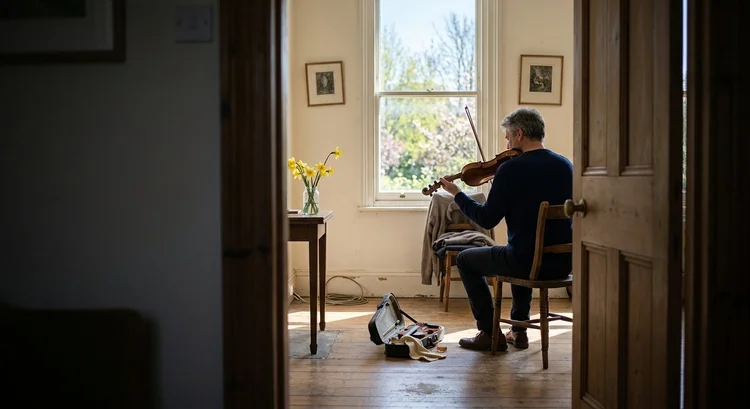
There is a piece most adult players are carrying around. Not in the case, in the head. It has been there for years, through a hundred hearings and a dozen recordings, loved long before there was any question of playing it. Then one evening the score is finally open on the stand, and it is every bit as beautiful up close, and the bow comes down, and somewhere in the first few lines the whole thing comes apart. The score goes back in the drawer. Something safer takes its place, something that holds together and leaves you a little cold.
That drawer is where a great deal of adult repertoire goes to wait, and the waiting comes from an idea that sounds sensible and is not quite true: that you play the music you love once you have earned it, and until then you play the music you are allowed.
I do not think repertoire works like that.
Why "At Your Level" Is Not the Only Question
Grades and repertoire lists are useful. They tell you roughly where a piece sits and they hand you candidates to consider, which is no small thing when the violin repertoire is as large as it is. What a grade cannot do is describe you. A repertoire level describes a piece. It cannot describe a player.
Two adults sitting at the same nominal level can be almost nothing alike. One has secure intonation and shaky shifting; the other has a fluent bow arm and pitch that wanders once it climbs above third position. A single number cannot hold that, and it was never meant to. So a list is a fine place to start looking and a poor place to stop thinking, because the thing that decides whether a piece is right is not the level printed beside it. It is how that piece meets the particular playing you have now.
Why Adults Often Choose Pieces That Are Too Hard
You may be here if: you have loved a piece for years, and the ear that loves it is far ahead of the hand now asked to play it.
There is a pattern I see often, and it is worth naming kindly. Adults tend to arrive with taste that has run ahead of their hands. You may have loved a piece since university, heard it a hundred times, followed it through a dozen recordings, and built an ear for it far more developed than the fingers that now have to answer. That gap is not a failure of talent, and it is not a sign that you started too late. It is one of the ordinary results of coming to the violin as a whole person with a musical life already behind you.
When an adult brings me a piece they have been fighting for months, I am rarely thinking that they chose badly. They chose by desire, which is the right instinct pointed at a question it cannot settle on its own.
Why Easier Is Not Automatically Better
The opposite advice fails just as reliably. A piece that sits so far inside your reach that it asks nothing new of you can be wonderful to play, but it cannot do the same developmental job as a piece that asks you to acquire something. For an adult giving up real time to practise, that difference matters. Motivation is not a decoration sitting on top of the learning. For most adult players it is the thing that keeps the violin out of its case on a tired evening. So a piece that is too hard often needs a better-matched difficulty rather than a smaller one.
Useful Difficulty, Not Just Difficulty
This is the idea I would hold on to. The question is not whether a piece is hard. Almost anything worth playing is hard somewhere. The question is whether the difficulty is useful.
A difficulty is useful when you care about the music, when you can point to what is hard about it, when some of those demands are already within reach, and when you can watch yourself make progress on the rest. A difficulty turns unhelpful when nearly everything is unfamiliar at once, when you cannot tell why a passage keeps collapsing, and when practice becomes the repetition of the same failure with no way to see whether anything is moving. That is how players end up spending months on the wrong thing without realising it. The word that matters is not hard. It is useful.
Comfort, Development, Destination
Most of the repertoire in front of you falls somewhere on a single line, running from what you can already play to what you cannot play yet. Where a piece sits on that line changes what it is for.
Comfort
Asks for things you can already do. Its value is refinement, sound and the confidence of playing something well end to end.
Development
Contains one thing you cannot yet do consistently, but you can name it and work at it directly.
The sweet spotDestination
The one you love and cannot yet play, because it asks too many unfamiliar things at once to be today's main project.
A comfort piece is not a waste of anyone's time. A development piece is the one that earns its place in your week, because it teaches you while you play it. A development piece is repertoire doing the job that deliberate technical work does elsewhere in your practice: giving one useful problem somewhere musical to live. And a destination piece is not to be abandoned; you keep it in view and build the road toward it with repertoire that teaches, one at a time, the things it will eventually ask of you. When someone tells me they want to play the Bach Chaconne, I do not answer with a grade or a number of years. I want to know what the Chaconne will demand of their playing, and then find the pieces that bring those demands within reach.
If you have a piece you cannot place on that line, you are welcome to bring it to a first lesson and we will work out together which of the three it is. That single answer usually changes what you practise next. Book a first session →
Five Questions Before You Commit
You can run this on any piece you are considering, tonight, without anyone's help. The second question needs a vocabulary, so name the difficulty in concrete terms rather than calling the whole thing hard:
Do I actually want to play this?
Not because it is famous, and not because someone called it important repertoire, but because I want to hear myself play it.
What exactly is hard here?
Name it from the list above. "It is too hard" is not something you can practise. "The shifting in the third line is not secure" is.
What would this piece teach me?
A good piece has a job. If you cannot say what the difficulty is buying you, that is worth noticing before you hand it three months.
Can I see myself making progress?
Not whether you could play it in two hundred hours, but whether you can tell, week to week, that something is changing.
Does it carry me toward the music I want to play?
A piece that builds the exact skills your destination piece needs is worth more than one that merely sits at the right level.
If you cannot answer the second question, that is usually the real signal. It tends to mean the trouble is not the whole piece but one thing inside your playing that has not been named yet, and naming it is most of the work of hearing what is actually wrong.
A repertoire level describes a piece. It does not diagnose a player.
When the Piece You Love Is Too Hard Right Now
A destination piece is not a locked door. It is a map. Once you know the two or three things that make it hard for you specifically, the loved piece stops being a wall and becomes a direction, and almost everything you choose in the meantime can be pointed at it. A study that isolates the one shift. A slow movement by the same composer that trains the sound without the fireworks. One page of the piece itself, taken at half tempo, worked as its own project. The music does not have to come down to your level. You build toward it, and it waits.
Choose Repertoire Around Your Life, Not an Imaginary Schedule
There is a second fit that almost no repertoire advice mentions. A piece has to suit your hands, and it also has to suit your week. An adult with thirty minutes on a Tuesday and a weekend that keeps getting interrupted can be capable of learning a demanding piece and still be poorly served by it, because it will swallow every scrap of attention they have and give little back in the time available. A piece that fits your hands can still be wrong for your week. What your real life can give its attention to is a large part of what it means to build a violin practice that survives an adult schedule.
The One Part That Is Hard to Do Alone
Most of this you can do yourself, and you should. You can rule out the pieces you do not want to play, name what is difficult, and notice whether you are moving. One judgement stays hard from the inside. When a passage keeps falling apart, you often cannot tell whether the piece is beyond you or whether one specific thing in your playing is not yet secure enough to hold it up. From inside the struggle those two feel almost identical, and they point to opposite decisions. One says wait. The other says here is the single thing to work on, and the piece is closer than it feels.
A recording will show you the failure plainly. What it will not tell you is the cause: whether the piece is genuinely ahead of you, or whether one fixable thing is holding up something otherwise within reach. That distinction is most of what I am listening for when an adult plays me something they are unsure about. A piece that is genuinely beyond someone and a piece held back by one underprepared skill often look and sound quite different from the outside, even when they sound equally rough to the person playing.
If you cannot yet name what is difficult, the problem has moved from choosing to diagnosis, and each of these has its own way through:
I cannot tell what is actually wrong when I play it.
Hear what is wrong →The notes are there, but the tuning wanders.
Improve intonation →The notes are there, but the sound is not.
Improve tone →I have named it, but I do not know what to do with the time.
What to practise →You Do Not Have to Give Up the Music You Love
The fear underneath all of this is that being an adult violin learner means a long stretch of music you do not care about, endured in the hope of one day earning the music you do. It does not have to go that way. The pieces you love can sit on the horizon as destinations while you choose, week by week, the repertoire that quietly builds the playing they need. You are more capable of this judgement than you have probably been told. What tends to be missing is not talent and not discipline. It is an accurate reading of the distance between the music in your ear and the playing in your hands, and that distance can be measured, and it closes.
One lesson to find out whether the piece is wrong, or just early.
You bring the piece you cannot place. I listen, tell you whether it is beyond you or a single change away, and we work out what to play now so the music you love comes within reach. You leave with a clear next step and a way of choosing for yourself.
Book Your First Online Violin Lesson
Subscribers are welcome to 20% off a first lesson.
Before you book
How do I know if a violin piece is too hard for me?
A useful test is whether you can say what is hard, not only that it is hard. If you can point to the specific demand, the shifting or the string crossings or the bow distribution, and some of the piece sits within reach around it, it is probably a stretch you can work with. If nearly everything feels unfamiliar at once and you cannot tell why passages keep collapsing, the piece is likely asking for too many new things at the same time. This test names the difficulty more reliably than it delivers the verdict, because whether one weakness is holding up an otherwise reachable piece is hard to judge from inside your own playing. When you can name what is hard, you can usually decide what to do about it.
Should I play violin pieces that are above my level?
Sometimes, and it depends on why. A piece above your current level can be a strong teacher when you have solid basics and it asks for one or two new things you can isolate and practise. It becomes a poor use of your time when it asks for many unfamiliar things at once, because practice turns into repeating failure with no way to see progress. The point is not the label above your level. It is whether the difficulty is teaching you something you can get hold of.
I have wanted to play a piece for years and it is still beyond me. Do I have to give it up?
No. A piece you love that is currently out of reach is better treated as a destination than as a mistake. You keep it in view and choose repertoire that builds the specific skills it will demand, so the distance closes from your side rather than the piece coming down to meet you. What a teacher adds here is a clear reading of what that particular piece will require of your playing, which turns a vague someday into an actual route. The music you love is rarely the wrong choice. It is usually early.
How do I know if a piece is too easy to be worth my time?
A comfort piece is not automatically a waste, because refinement, sound and phrasing are real work even in music you can already play. It becomes a problem when nothing in it is changing your playing and you are giving up practice time you cannot spare. If you cannot find a single thing the piece is developing, that is the signal to add something with a clearer job. Easy is fine when you have chosen it on purpose; the trouble is drifting into it by default.
Do I need a violin teacher just to choose what to play next?
For most of it, no, and this article is meant to hand you the method to do it yourself. You can judge whether you want a piece, name what is difficult, and notice whether you are making progress. The one place another ear earns its keep is telling apart a piece that is beyond you from one you are underprepared for, because those two often look and sound quite different from outside, and nearly identical from within. That single distinction is often the difference between shelving a piece for a year and picking the right thing to practise this week.
Continue reading