How to Play Violin Without Tension
Published August 2026
Why the tightness comes straight back the moment your attention returns to the music, and how to work out what it is doing before you try to relax it away.
Loosen the thumb and it lets go. Fifteen seconds later, with your attention back on the music, it has closed around the neck again. Most players read that as a lack of discipline, or as proof they are built wrong for the violin. It is usually neither. The tightening tends to be doing something, and until you work out what, relaxing the thumb only clears the space for it to come back.
The short version is this. Unnecessary tension is a symptom, not yet a diagnosis. Before you try to relax a tight thumb, jaw or shoulder, it helps to notice when the extra effort appears and what changes when it does. It may be stabilising the violin, producing more force than a note needs, bracing for a difficult shift, or repeating a learned pattern. Telling the tense part to relax rarely holds on its own, because it does not touch the reason the part tightened. What follows is a way to find that reason, and most of it you can do tonight.
Why Violin Tension Keeps Coming Back
A relaxed hand is where we want to arrive, and it makes a poor place to start, because it asks a tense player to feel differently on command, which often does not hold once attention returns to the music. The tightening is usually a response. Something in the playing seems to be asking for it, and the moment your attention returns to the notes the request comes back and the hand answers. This is one reason the same advice that frees one player does nothing for the next.
So the useful move is to stop pushing the tension down and start asking what it is for. Playing the violin asks for real work, fingers pressing, the bow arm carrying weight, the hand holding its shape, and none of that is the problem. The problem is effort that arrives early, outstays its job, or runs past what the note needs. Give what your tension is doing a name, even a provisional one, and for the first time you have something you can change.
The Same Tight Thumb, Two Opposite Fixes
Picture two players with the identical complaint: a left thumb that clamps the violin neck. One presses every finger into the string much harder than it needs, so the thumb braces underneath to push back. The other is afraid the violin will slip during vibrato, so the thumb has taken on part of the work of holding the instrument.
Same thumb. Same knot in the same place. Different causes. Tell the first player to lighten the fingers and the thumb often softens on its own. Tell the second the same thing and little changes, because for them the thumb was helping to hold the violin, and lighter fingers do nothing about that. This is why the internet full of tips does not settle it for you. The tips are mostly fine. What is missing is a way to know which one is yours.
Most of what follows is how to work out which one is yours on your own.
What Is Your Tension Doing?
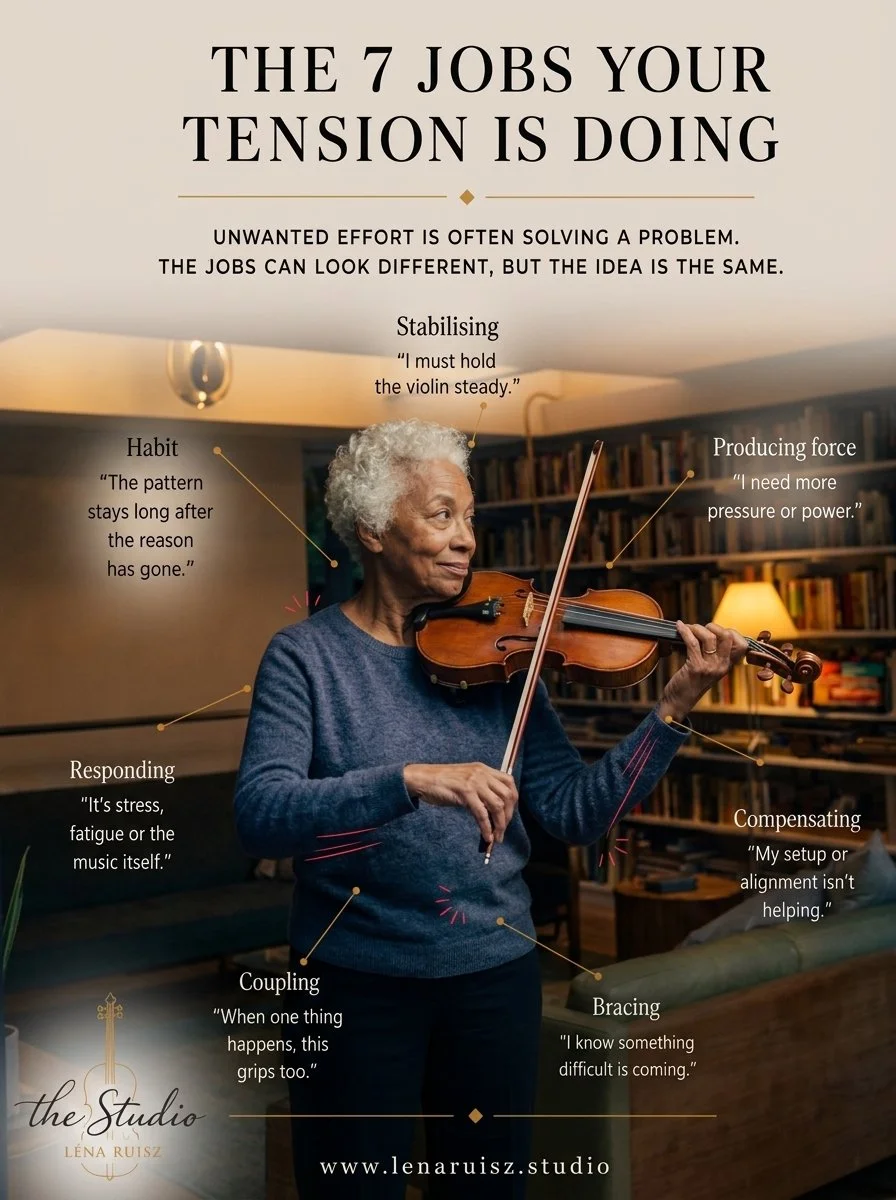
These are the questions I work through when unnecessary effort keeps coming back. It is a practical way to investigate, not a scientific list of the things tension does. Is it stabilising, gripping because the body suspects the violin will move? Is it producing force, pressing a note harder than the sound requires? Is it compensating for an angle or a setup that leaves one part reaching? Is it bracing, tightening a beat before a difficulty arrives? Is it coupling, where one movement drags another with it, so a finger cannot fall without the thumb squeezing? Is it responding to stress, fatigue or the music itself? Or is it habit, a pattern that stays long after its reason has gone, which is why you can release it on command and find it back within seconds?
Most players recognise two or three of these at once, and often more than one is true together. That is normal, and useful. Asking the questions is what lets you stop treating every different tightness as one problem with one fix.
When Does the Tension Start?
You may recognise this: you can point to where you tense, and yet you have never once caught the moment it switches on.
Here is the question that turns a sensation into something you can work with. Not where you feel it, you know where, but when it begins. Take a passage that reliably tightens you and find the instant the effort switches on. Some hands are tight before the bow has even moved. Some stay loose until a shift and then seize a beat ahead of it, and that timing is a clue in itself, because a grip that arrives before the movement is anticipation rather than the movement itself. The shift may not be causing the tension. What you are asking your body to prepare for may be.
There is a second question worth as much as the first: does the effort ever switch off? A finger has to press, a shift needs a moment of stability, a loud note asks more from the bow arm. The trouble starts when the effort outstays its job. The finger presses and the thumb keeps squeezing long after. The shift ends and the shoulder stays raised through the whole next phrase. Good violin playing is never zero effort. The skill is spending force when the note needs it and releasing it once the note is done. When you cannot find where a tension starts, try to find where it should have stopped.
Is Your Left Hand Helping to Hold the Violin Up?
The question is not whether the left hand contributes to supporting the violin. Depending on your setup and your technique, it may, and generations of players have shifted and shaped phrases with the hand sharing that work. The useful question is whether the way it is supporting the instrument still leaves enough mobility for the movement you are trying to make. A hand asked to both anchor the violin and oscillate freely for vibrato at the same time can end up doing neither well, and the moment you reach for the vibrato the grip fights the motion.
You often find this out the day you try to free the hand. As it lets go, the violin can start to feel less secure, so the jaw clamps down to take up the difference, and now there is an aching jaw in place of a tired hand. The load moved. It did not leave. One of the first things I watch is what changes when a player releases the thumb: if the shoulder rises or the jaw closes straight away, the supporting work has simply moved somewhere else, and that is worth knowing before deciding the thumb was ever the real trouble.
The research is a useful caution here. In a small case-control study of 20 professional violinists, ten with neck or shoulder complaints and ten without, the players with complaints showed greater activity in several measured neck and shoulder muscles, but not significantly greater force clamping the violin between jaw and shoulder. That does not tell us what causes an individual amateur's tension. It does show why the place that feels tight and the mechanical variable behind it should not automatically be treated as the same thing.
Why Vibrato and Shifting Expose Violin Tension
A support habit can sit unnoticed in first position, where the hand does not need to travel very far. Vibrato and shifting often expose it because both demand more mobility. If the hand is carrying more of the violin's support than the movement comfortably allows, the thumb or fingers may grip as soon as the hand needs to oscillate or travel. The problem is not that the hand contributes to support at all, but that its supporting job and its moving job have stopped cooperating. Many adults read this as a ceiling. More often the new technique asked the hand to do two jobs it had been combining, and pulling them apart is a coordination problem with a coordination answer.
When the Jaw, Neck or Shoulder Takes Over
Jaw and neck tension is often the second half of a support question. When the left hand gives up some of the holding, something has to make up the difference, and the jaw is the nearest candidate. A sore point where the chin rest sits and a jaw that clenches through a hard passage can share the same patch of skin and still be two different things, one about contact and pressure, the other about what the jaw is being asked to secure. Notice when the jaw tightens. If it clenches only as you free the left hand, it may be taking over the hand's old job, and the change worth testing is upstream of the jaw.
The right side deserves the same question rather than a blanket instruction to drop the shoulder. A right shoulder that rises is often following an arm that has to reach, because of where the violin is held and angled, rather than a shoulder that forgot to relax. So ask when the bow-side tension appears. If it appears mainly in forte, force becomes a variable worth testing. If it appears mainly at the tip, reach and instrument angle are worth testing. If it never lets go between strokes, you are back at the switch-off question, this time in the bow hand.
When the Variable Is Not Where the Hand Is
Not every tension is mechanical. Sometimes the body braces because a passage feels exposed, or the tempo climbs, or someone is listening, or a loud dynamic seems to demand more grip than it really does. The hand has not moved anywhere new. What has changed is what the player is bracing against. If a passage tightens you alone but locks you solid the moment it is heard, the variable to test is not the position of the thumb but the pressure of the moment.
Can a Shoulder Rest or Chin Rest Cause Violin Tension?
Sooner or later most people go shopping, a different shoulder rest, then a taller one, then an ergonomic chin rest, then another. Setup does matter, though not always in the direction we expect. One small study of professional violinists found that increasing shoulder-rest height increased the force holding the violin down and reduced reported comfort. That does not mean a high rest is wrong for you. It does mean that more support should not automatically be assumed to mean less muscular work. A later crossover study of 38 pain-free professional violinists found only small biomechanical differences when an ergonomic chinrest with a low shoulder rest was compared with their usual setup. Neither study tells an adult amateur which rest to buy.
So treat setup as one variable to test, one change at a time, rather than a purchase that ends the search. When every new rest fixes one thing and unsettles another, it is worth stepping back from the equipment and asking what mechanical problem you are actually trying to solve. What tends to help more than the next accessory is understanding what the chin rest and the collarbone are actually being asked to do.
A Ten-Minute Test You Can Run Tonight
Tonight is only for gathering information. You are turning "I am tense" into a sentence exact enough to act on, before you change a thing. Choose two short stretches, one easy and one that reliably tightens you, play the hard one and notice only when the effort starts and whether it ever stops, then film it from an angle that shows the left hand and the shoulder. Then follow the branch that fits what you found.
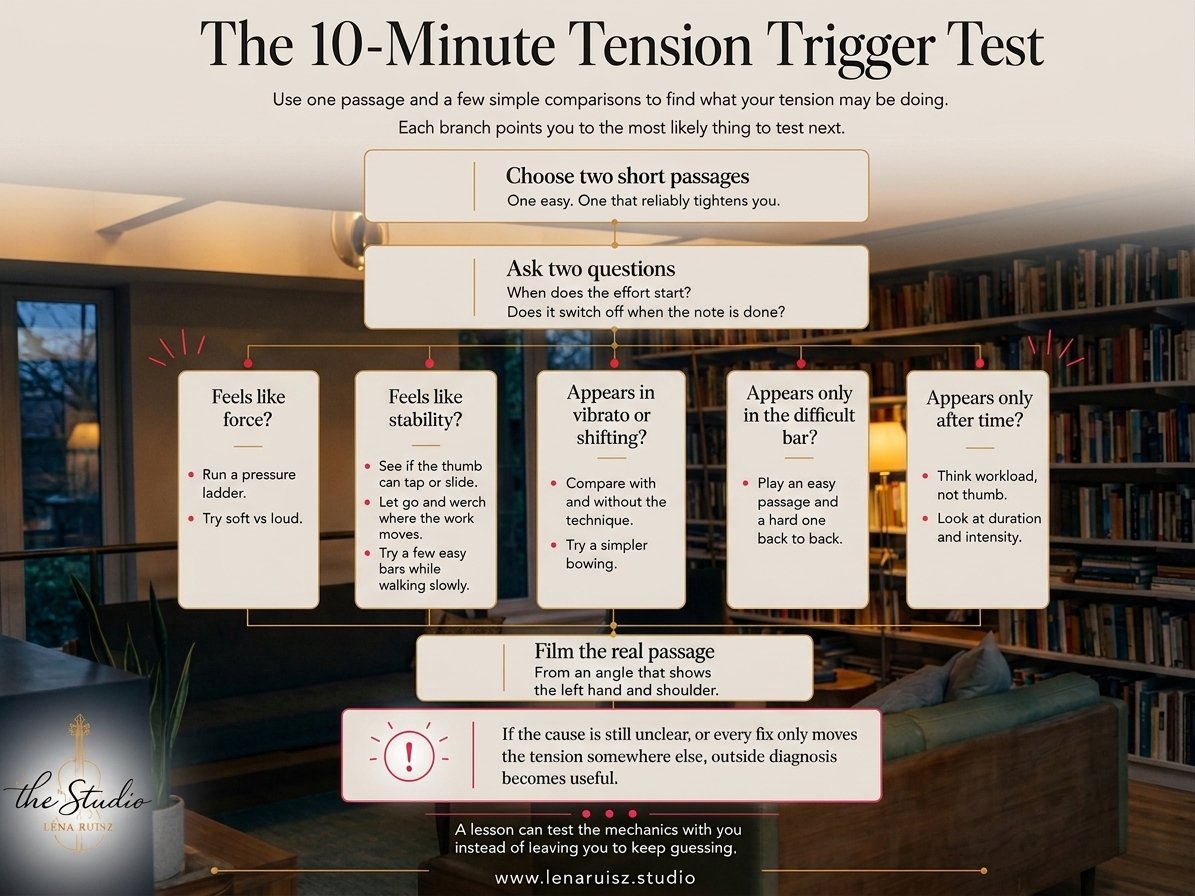
Each branch is a small experiment, not a verdict. If it feels like force, ease the finger off a stopped note until the sound starts to fail, then add back only enough weight to make it speak, and play the passage soft then loud to see whether the grip tracks the volume. If it feels like stability, test whether the thumb can still tap or slide while you play, then briefly reduce that support only as far as you safely can, without risking the instrument, and notice whether another part of the body immediately takes over. If it lives in vibrato or shifting, play the passage with the technique and without it and watch whether the tension leaves when the technique does. If it appears mainly in the hard bar, play an easy passage and a hard one back to back. And if it appears only after you have been playing for a while, workload and fatigue become variables worth testing too.
If one change frees the tension clearly, you have a lead worth following. If every change only moves the tension somewhere else, that is the point where an outside pair of eyes starts to save you time, and you are welcome to bring the passage to a first lesson.
When It Is Time to Stop Self-Diagnosing
One line matters more than any of this. Everything above treats tension as a playing-mechanics question, and that frame only holds while you are not trying to explain a persistent physical symptom. Pain that lingers or keeps returning, numbness, pins and needles, weakness, a loss of dexterity or control, or movement that has become restricted, none of that is something to experiment your way out of at the music stand. Those signs call for assessment by a qualified health professional, and a sudden increase in playing load is a recognised trigger worth mentioning to them. Playing technique is one field. What your body is reporting is another.
What a Teacher Adds That a Camera Cannot
By now you may have filmed yourself and seen something move. That is real progress, and it is also where doing this alone reaches its edge. A recording can show you that the shoulder rises before the shift. It cannot, on its own, tell you whether the change that matters is the support, the reach, the way the shift is prepared, the tempo, or what you are expecting of the movement. The camera gives you observation. Deciding which variable to test, and reading whether the guess was right, is a different skill.
That is most of what a lesson is. You bring the passage, the shift, the vibrato, the bow stroke, the exact place the trouble keeps happening, and we start there. I change one thing at a time, watch what happens in the instant before the tension, and we test one plausible explanation against another until the picture narrows. A problem carried for years can become legible in a single session, once the right variable is found. Legible is not the same as cured, and I would not promise otherwise. But there are usually variables we can test, and knowing what a tension is for changes what you practise the next morning.
When you cannot find where a tension starts, try to find where it should have stopped.
Still know where you tighten, but not why?
Bring the passage where it happens. Together we find when the tension starts, test the likely causes one at a time, and turn it into something specific to practise. You do not need to have worked out the cause first. That is the part we do together.
Book Your First Online Violin Lesson
Common questions about violin tension
Why am I so tense when I play the violin?
Unwanted tension can be your body solving a problem: holding the violin steady, pressing harder than a note needs, bracing for a difficult bar, or repeating a habit whose reason has gone. That is why "relax" on its own rarely holds, it treats the tightness without touching the cause. The first useful step is to notice when the effort begins and what changes it, rather than fighting the muscle directly.
How do I relax my left hand on the violin?
Find out what the hand is doing before you try to loosen it. If your left hand has been helping to hold the violin up, relaxing it on command tends not to last, because the support job returns the moment your attention does. Test whether the thumb can still tap or slide as you play, then ease the finger pressure to the lightest weight that keeps the note clean. Much of the tightness is often work that was never needed.
Why does my thumb squeeze the violin neck?
A squeezing thumb is often a symptom rather than the source. It can push back when the fingers press too hard, and it can clamp when the hand is helping to hold the violin up. Test whether lightening the fingers releases it. If it does not, support or another coupled movement becomes the stronger hypothesis, and the change worth making is elsewhere.
Why do I clench my jaw or raise my shoulder when playing the violin?
Both often appear the moment the left hand stops holding the violin up, because the jaw and shoulder are the nearest things that can take over. A rising shoulder can also be following an arm that has to reach. Forcing either down tends to start a new fight. Notice the exact moment it happens, before a shift, only in loud playing, only as you free the hand, and change that condition rather than the muscle.
Why do I get tense during vibrato or shifting?
Both ask the left hand to become mobile, and a hand that has been helping to hold the violin up can struggle to travel or oscillate and hold at the same time. In first position the habit stays hidden; add vibrato or a shift and the grip fights the motion. This is usually a coordination question rather than a ceiling. Separating the two jobs, holding and moving, is what tends to free the note.
Continue reading