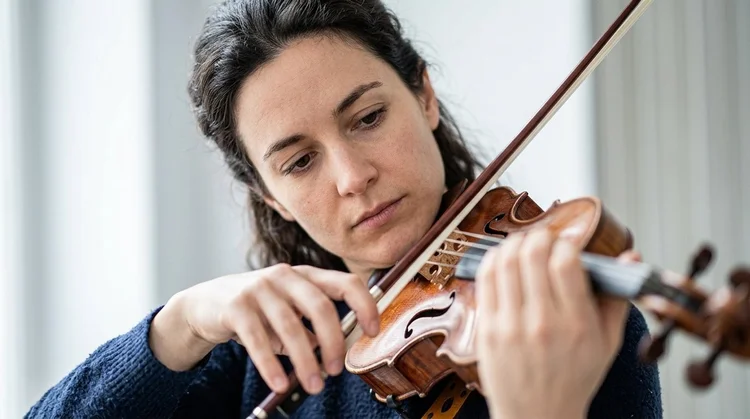
How to Improve Violin Tone and Bow Control

Last reviewed: August 2026
Change one small movement in the bow and the instrument answers at once. This is how to hear what it is telling you.
How to Improve Violin Tone: Start With the Bow
You can play a passage cleanly and still feel that the sound is not yours. It scratches and will not let go, or it thins towards the tip of the bow, or it stays small however hard you lean into it. Tone is the most responsive thing on the whole violin, which is what makes it such a pleasure to work on once you know how to listen. Change one small movement in the bow and the instrument answers at once, sometimes with a sound so much clearer than the one before it that you stop and grin. Most players never find this out, because the instinct when a sound goes wrong is to push harder rather than to hear what the violin just told you.
That is the shift worth making. Once you have worked out that a rough passage belongs to the bow and not the left hand, the scratch stops being a verdict and becomes a question you can chase down. If you are trying to improve violin tone, this is where it starts, with the bow rather than with everything at once. There is a knack to reading it, and it is completely learnable: the players who improve fastest build the sound they want and, alongside it, the ear that catches why it slipped.
Before I look at the bow, I listen to the body. Where the feet meet the floor, whether the knees are free, whether the hips carry the player or brace against them, whether a grip has gathered in the shoulder or the bow hand. The freest, most singing tone tends to come from a posture that is relaxed and awake at the same time, aware of itself from the feet up. So much of what sounds like a bow problem begins as a held breath somewhere in the chest, and the moment a player feels that and lets it go, the sound opens on its own. Sound is physical before it is mechanical, and that is a gift, because the body is something you can feel your way into.
Why Your Violin Sounds Scratchy, Thin or Weak
Scratchy is surface noise sitting inside the string, many times coming from too much pressure. Airy is the opposite trouble, breath with no centre, the string never quite caught. Thin can be perfectly clean and still leave you wanting more, because it is missing body rather than clarity. Weak will not carry to the back of a room, which is the separate matter of projection. Harsh has too much edge, brightness that has tipped over into force. So if you are wondering how to make your violin sound better, the first move is always the same: name the sound you are hearing, because each one points to a different thing the bow is doing. Every one of these is a good, useful sound in its place. The art is in using them knowingly and on purpose, not arriving at them by chance.
When someone plays for me, I do not begin by deciding whether the tone is good or bad. I listen for where it changes inside the sound, where it loses its ring, and whether the change follows the bow or the note. That is the ear you are building, and it sharpens faster than most people expect.
What Controls Violin Tone? Bow Speed, Weight and Contact Point
Speed and weightFast and light, or slow and heavy. Trade one against the other and the sound holds its centre.
Speed and contact pointThe nearer the bridge, the more speed the string asks for before it will ring.
Weight and contact pointThe nearer the bridge, the less hand it takes before the note begins to grind.
Three things the bow does account for most of what you hear: how fast it moves, how much pressure reaches the string, and where it meets the string between the fingerboard and the bridge, the spot players call the contact point. They are not independent controls, which is why it helps to hold them as the three corners of one triangle. Underneath all three sits one mechanism worth picturing: the bow hair catches the string, pulls it sideways, lets it snap back, and catches it again, hundreds of times a second. A clean, ringing tone is that catch-and-release running in a steady pattern, and every kind of bad sound is that pattern coming apart in a particular way.
The middle corner is worth a careful word, because it is where most players go wrong. The physical quantity acting on the string is pressure, and in teaching, weight is a more useful way of pointing your attention towards it, towards letting the arm's own mass reach the string rather than gripping and pushing from the hand. Much of that weight arrives through the first finger resting on the stick, and learning to feel it there, to hand the arm's weight to the bow instead of pressing down, is one of the quickest ways to change what you hear. It is worth trying the moment you next pick up the violin.
Pressure shouts. Some music wants exactly that, and the whole art is knowing you are choosing it rather than stumbling into it. Allowed weight lets the violin sing; pressing tends to close the sound up. Think of a singer: push the note out from the throat and you hear the strain, but let the breath drop and support it from the body, and the same volume fills the room with ease. The violin does the same. Simon Fischer has built much of his teaching on this distinction between weight and downward pressure, and few things change a player's tone as quickly.
How Bow Pressure, Speed and Contact Point Work Together
Move one corner and you change what the other two need to be. Bring the bow closer to the bridge and the weight that felt full a second ago starts to grind, because near the bridge the string wants more speed or a lighter hand to stay stable. Slow the bow right down and that same pressure now crushes the note flat. This is why a single instruction so often misses. Telling a player to press less corrects one corner, and in doing so changes what the speed and the place were doing, so the sound lands somewhere nobody predicted. Improving violin tone comes down to how these three work on each other, more than to any one perfect bow technique.
Erwin Schoonderwaldt, whose experiments mapped how far each corner can be pushed before the sound falls apart, found that the usable range of bow force is not fixed. It shifts with the speed of the bow and its distance from the bridge. Once you know that, the search changes character.
You stop hunting for the one correct setting and start feeling for the region where the three agree.
There is a fourth thing to watch, and it works as a condition on the other three. The bow has to keep its relationship steady while it travels, and one that drifts across a long stroke will lose a tone that started beautifully, because the place has moved under it. A sound strong at the frog and thin by the tip is often a wandering bow path, not a weak arm, which is a relief, because a path is easy to see and correct.
Each sound also tells you where to test. A scratchy violin tone usually calls for a test of speed against force and contact point. A thin one asks whether the string is getting enough energy to ring, and a weak one is really a question of projection. A harsh tone points to a combination grown too aggressive for where the bow is sitting, while squeaks and whistles come from the bow briefly losing its grip on the string, the E-string whistle most stubborn among them and never solved by pressing harder. When a problem shows up on one string alone, test that string and the bow together before changing the whole stroke.
A Five-Minute Violin Tone Exercise
This one is best on an open string, where the left hand is out of the way and your ear has only the bow to follow. It asks a different question from the open-string test that sorts bow from fingers. Here you already know it is the bow, and you are finding out which corner is doing the talking.
- Play one long, comfortable bow and listen to it without trying to fix anything.
- Play it again faster and lighter, then slower and heavier, and hear what each one does to the sound.
- Keeping the speed and weight where they sounded best, move the contact point slowly from near the fingerboard towards the bridge and back, and listen for where the sound gains a core and where it turns harsh.
- Find the combination that rings the most freely, and play it three times to fix the feel of it in your arm.
- Take a two- or three-note fragment from the piece you are working on and reproduce that same coordination, then let the music's rhythm and speed come back one layer at a time.
What those five minutes give you is a way of listening, and it is the most valuable skill you can own on this instrument. Once you hear a good sound come into being, it becomes your standard, and from then on your ear and your hands keep working towards it on their own, because now they know what they are reaching for.
How to Make Your Violin Tone Reliable
There is a real satisfaction in closing the gap between producing a good sound and repeating it on demand. Most adults know the first half already: the note that lands just right by luck and then vanishes the next day. Producing it once means the corners happened to line up. Owning it means knowing what lined them up, so you can call up a richer, warmer tone when the music asks for it and find it again when it slips away. This is what reliable bow control actually is, and it is why tone is best thought of as a palette. A skilled player chooses among many sounds, warm here, bright there, pulled back to a whisper for a phrase that asks for it, and that freedom of choice is what years of listening buy you. Most violin tone exercises stop at the open string; the ones that change your playing are the ones you carry into real music, a phrase at a time. The players I have watched travel furthest were rarely the most gifted. They were the ones who grew curious about what was happening in their own sound.
The older schools understood this in a way modern default teaching often hurries past. What I keep from them is the life inside a single bow stroke, the swell and the taper that let one note breathe instead of lying flat from end to end. These are old ideas, a body of exercises whose principles agree across many of the historical violin schools and are carried into our own time through teachers like Dounis. Mozart himself used them to teach his pupils, and learning to hear them is one of those moments that changes what you notice in every recording you love.
When Strings, Rosin, Bow Hair or Setup Affect Violin Tone
Sometimes it is the instrument after all, and the pleasing part is that you can find out for yourself before spending a penny. The test is a comparison. Play your open-string experiment on your own violin, then, if you can, hand it to another capable player, and play a well-set-up violin with your own bow. If your sound jumps forward on the other instrument, or someone draws a better one from yours, the setup is part of the story. If the trouble follows you wherever you play, it is living in how you are playing it, which is the part you can change.
Strings, rosin and bow hair all shape the sound where hair meets string, and a worn or glazed patch there can make a noise no technique will clean up. Fresh strings can help, and they will not stand in for reading what the bow is doing, so do the listening first. Anything structural, a soundpost that has shifted or a bridge sitting slightly wrong, is a job for a luthier and never a home repair.
What a Teacher Can Hear in Your Violin Tone That You Cannot
Almost all of this is yours to build, and you will get a long way on your own. You can already hear the difference between a scratch and an airy note, test the corners of the triangle one at a time, and carry the result into a phrase of music, and every time you do it you become a more independent player. There is one boundary that stays put, and it is worth knowing exactly where it is. You cannot hear yourself from outside, and you cannot see your own tension. A held shoulder, a hand gripping a shade too hard, a bow that has taught itself to drift, all sit in the one blind spot that both produces the sound and hides its cause.
You have the tools now. What a second pair of ears adds is the thing you cannot reach from inside your own body: where you are holding, what to release, where to be more precise, how the bow wants to sit in your hand for the sound you are after, and the feel of a free tone in your own arm, so that afterwards you can go looking for that feeling alone.
That is what a good lesson hands you, and it goes on working every time you pick the violin up afterwards.
Begin with one lesson.
We start with your own violin and the sound you are trying to reach, find what is producing the tone you have now, and you leave with something you can use the same day. No commitment beyond that is required.
Book Your First Online Violin Lesson
Subscribers are welcome to 20% off a first lesson.
Before you book
How much pressure should I use on the violin bow?
There is no single right amount, and letting go of the hunt for one is a relief. The weight the bow wants depends on how fast it is moving and where it is meeting the string, so what works an inch from the fingerboard will grind near the bridge. A better instinct is to let the arm's weight settle into the string rather than pressing down, then adjust it against the speed and the place. When the three sit in balance, the right weight stops feeling like effort and starts feeling like the bow doing the work for you.
Why does my violin sound scratchy even when my technique feels right?
Scratch can survive careful playing, and the reason is usually that the cause sits somewhere other than where it feels like it should. It often comes from too little speed for the weight you are using, or a contact point that has crept too close to the bridge, more often than from too much pressure. Sometimes the bow drifts partway through the stroke, so a sound that started cleanly comes apart in the second half. Testing the corners one by one on an open string, instead of pressing harder and hoping, is what turns a stubborn scratch into a problem you can locate and solve.
Can I tell whether my tone problem is my violin or my technique?
This worry stops a lot of players from trusting their own ears, and there is a reassuring way through it. The quickest signal is a swap: if a more experienced player draws a noticeably better sound out of your violin, or your own sound jumps forward on a well-set-up instrument, the setup is carrying some of the blame. If the same trouble follows you from instrument to instrument, it is coming from the bow, which is the part that answers to practice. Worn strings or hair can muddy the picture, so it is worth checking those first, and leaving anything structural to a luthier.
Can you really diagnose violin tone over a screen?
Yes, and tone carries better than people expect. The whole point is to find what produces the sound, so you can change it, and for that the screen is rarely the limit. Bow speed, the weight in the arm, the contact point, and the tension a player cannot see in their own shoulder all come through clearly enough on a decent camera and microphone. What matters more than perfect audio is that the work is about helping you hear and feel the change yourself, so it stays with you after we finish, and the one thing a recording cannot do is interpret itself.
Why can I sometimes get a good violin tone but not reliably?
This is one of the most common experiences on the violin, and it means you are closer than it feels. A sound that arrives by luck and a sound you can call up on request are two different achievements, and the gap between them is knowledge rather than strength: what your bow was doing at the moment it came right. Few players have ever had a way to catch that, so the good tone stays occasional. The open-string experiment gives you the way, by letting you change one thing at a time and hear exactly which one did the work.
Continue reading