How to Hear What Is Actually Wrong in Your Own Playing
Last reviewed: August 2026
You already hear that something is off. This is how you find out what.
The Loop That Stays Open
You know the feeling. You play a passage and something is off. Not wrong enough to name, just off. So you play it again. Still off. You slow down, you speed up, you try a different finger, and somewhere around the fifth repetition you notice you are not fixing anything. You are repeating it and hoping. Then the practice hour ends, and you honestly cannot tell whether you got better or simply more tired.
After enough sessions like this, something else starts to happen. You stop trusting your own judgement. You wonder whether you are practising badly, whether you are not suited to this, or whether the frustration is what learning the violin feels like. Usually the problem is more specific than that.
If you practise mostly alone, this is the quiet problem underneath a frustrating session. Putting in the time is not the issue. The issue is sensing that something is wrong while being unable to answer the four questions that would let you do anything about it: is this actually wrong, what exactly is wrong, why is it happening, and what should I do next.
In a lesson, a teacher closes that loop for you. They hear the thing before you do, name it, and tell you what to change. Then you go home and the loop opens again, because the part that closed it was standing in the room with you. What follows is how to close it yourself – a sequence I use with students and in my own practice, and which takes about the same time as playing a passage badly four times.
Why the Feeling of "That Was Fine" Is Unreliable
Researchers have found that self-evaluation is unreliable, even among highly trained musicians. In some studies, more accurate performers have underestimated themselves, while less accurate performers have overestimated their performance. For a violinist the practical point is simpler: the feeling that a passage went well and the reality of what happened are two different signals, and they do not always agree.
There is a second reason, and it is mechanical. Anything you have done many times becomes automatic and drops out of conscious attention. That is efficient – it is also why a habit repeated for months can stop registering as a problem at all. You are no longer noticing the thing itself. You are hearing what has become familiar.
The goal is to build a reliable way of noticing, and then to check what you notice against something outside yourself. You cannot fix what you cannot yet hear.
You cannot fix what you cannot yet hear.
Gathering Information Rather Than Passing Judgement
Before the loop, one principle worth holding: notice one thing clearly enough to change it. Cataloguing every flaw in a single session is counterproductive. If you hear six problems, do not automatically work on all six. Often one is upstream of the others – a tense bow arm can disturb tone, rhythm, and intonation at once, and an unstable pulse can make a passage feel technically worse than it actually is. The useful question is not what is wrong but which problem is worth investigating first.
Saying "that was bad" tells you nothing actionable. Saying "the shift arrived late and the bow sped up" gives you something to work with. The aim is to become more specific about your playing, which is a different thing from becoming harsher about it.
This is also where a tuner, a drone, and a recording stop being chores. Think of them as calibration tools – your inner sense of pitch and sound is the instrument, and these are the references you tune it against. Asking a recording whether the whole thing was good tends to produce a verdict rather than a direction. Asking whether a specific shift was in tune gives you something to act on. They are most useful when introduced one at a time and asked a single specific question.
Three Different Skills, Often Confused for One
Three abilities sit inside what most players call hearing what is wrong. First, noticing that something is off at all. Second, identifying what kind of problem it is – pitch, rhythm, tone, coordination, tension. Third, working out what is causing it. The first becomes reliable with practice. The second becomes far more precise. The third is where even experienced players can misread themselves.
The symptom and the cause are often in different places. A flat note can come from the finger, the preceding note, the hand position, the shift, the bow, tension somewhere in the arm, or even the way you are hearing the phrase. The sound tells you where to investigate. It does not tell you the cause.
The Four-Minute Loop
You do not need a system with thirty steps. One short loop, run consistently, does the work. In the studio we call it the four-minute loop, because that is roughly how long one pass takes once you know it.
Hear. Play a short span – four bars at most – or play it back, once, with your full attention on listening rather than performing.
Name. Say the specific fault out loud. Flat. Scratchy. Rushing. Tight. "Bad" does not count, because "bad" gives you nothing to do next. If you cannot name the fault, that itself is useful – the problem sits at the edge of your perception, and that is where the work is.
Locate. Find exactly where it happens – which beat, which shift, which string crossing. A vague problem cannot be fixed. A small, located one can.
Test your hypothesis. Ask what kind of problem it might be: left hand, bow arm, rhythm, coordination, tension, listening, or something about the passage itself – an awkward fingering, an inappropriate tempo, insufficient familiarity with the notes. Then test it rather than assuming it is correct. A good hypothesis saves time, but the test matters more than the guess.
Shrink and fix. Reduce the passage to the smallest unit that still contains the problem. Remove speed. Change one thing and listen to what that single change produces.
Retest against a reference. Use the drone, the click, or the playback rather than the feeling of "that seemed better." The internal sense of whether something improved and whether it actually improved are unreliably related, and the reference is the more trustworthy of the two.
Transfer. Rebuild the speed and the context gradually. A fix that holds at half tempo does not automatically hold at performance tempo – motor learning is context-specific and the fix needs to be re-earned at each stage. Expecting it in advance takes the sting out.
Two honest warnings: testing your hypothesis is where adults go wrong most often, and it is precisely where an experienced ear saves weeks. And transfer is more fragile than it feels – a fix that works slowly in isolation will need re-earning in context. That is how the process works, for everyone.
Worked Example: Bow or Left Hand?
This is the single most useful question in the practice room, and the one adults can almost never answer by feel alone. A fast passage sounds muddy and slightly out of tune, and the natural assumption is that the fingers are missing. Sometimes. The bow is just as often the cause – and the experience of diagnosing it wrongly is worth understanding before it happens to you.
You hear a note arriving sharp and assume the finger is too high. You practise the placement repeatedly. Nothing changes. Then you try the same passage at half speed without vibrato and discover that the preceding note is already slightly sharp, so the hand is arriving from the wrong position. The note you were trying to fix was a symptom of what came before it.
Or: you hear a scratchy note and reduce the bow pressure. It still scratches. Then you notice the bow is travelling too slowly near the frog. The sound problem was real. Your explanation of it was wrong.
This is what makes the test-your-hypothesis step more than a formality. Test the left hand on its own: play the same notes pizzicato, so the bow is out of the equation entirely. If the pitches become cleaner when you pluck them, you have learned something useful – the left hand may be less of the problem than you thought, and you can now investigate what the bow is adding that changes things. Then test the right arm: bow the passage on open strings, or on a single repeated note, so the left hand is out of the picture. If the sound becomes scratchy or uneven here, with no fingering to blame, you have a starting point on the right side.
Notice what happened: you removed one variable at a time until the truth had somewhere to show itself. You did not try harder. That is the whole game in miniature, and it applies to almost any problem the loop turns up.
A student ran those two tests last spring on eight bars of Handel that had defeated her for three weeks. Pizzicato, the pitch was clean. Open strings, the sound thinned in the upper half of every down-bow. She had been drilling her fingers for a problem living in her bow arm. The passage came right inside a fortnight, and the fortnight was not the interesting part – the ninety seconds in which she found out she had been working on the wrong hand was.
The Recording You Keep Avoiding
Many adult players resist recording themselves, and the feeling of pressing play can be genuinely uncomfortable. Recorded playback strips away the physical sensation of making the sound, and what remains can sound thinner or simply unlike what you thought you were producing. This experience is nearly universal and does not entirely disappear with familiarity.
The technique that makes recording useful is to keep the excerpt short and listen for one thing only – ten to thirty seconds, not a whole piece. Before pressing play, decide what you are listening for: pitch, tone, or pulse, one of those. A short recording heard for a single quality is a tool. A long one heard for a general impression is only a way to feel bad. Think of it as gathering one piece of information, then getting back to work.
What recording gives you is a perspective much closer to that of a listener than the physical sensation of playing can give you. That distance is what makes it uncomfortable and what makes it one of the simplest ways to begin hearing your playing from outside your own perspective.
Two Kinds of Diagnosis
The loop tells you whether a correction worked in the next five minutes. There is a second kind of diagnosis that is slower and harder: not what went wrong in this passage today but what keeps coming back, week after week, and what it is actually telling you.
Progress on the violin is often too gradual to feel from inside the movement. The passage that frustrated you for three weeks may now feel ordinary, absorbed so thoroughly that the difficulty has simply become invisible from where you stand. Without a record of some kind, that change is invisible too.
When something has been frustrating you for a while, play a short attempt and set it aside. Note what you were trying to change. Come back to the same passage two or three weeks later and play it again before listening to the earlier recording. The comparison is often more informative than months of internal assessment.
What You Can Learn Alone, and Where an Outside Ear Changes Things
A great deal of genuine self-diagnosis is learnable. Players who run the loop consistently describe a gradual shift in how they listen while they play – more specific, less anxious about whether it sounds right. Motivated, analytical adults can develop this further than most people assume.
There is a real boundary, though, and it is more specific than it first appears. Four things stay hard alone, and they happen to be the four most interesting problems in violin playing.
The first is seeing what sits outside your own line of sight. A small collapse in the wrist, a shoulder that lifts a few millimetres on the shift – these accumulate for months before they announce themselves through discomfort or a passage that will not move. When someone plays for me, that is what I watch for in the first ninety seconds, before I have heard anything about the piece.
The second is distinguishing a cause you cannot yet perceive. This is the test-your-hypothesis step again, and it is where an experienced ear collapses six weeks of alternating theories into a single answer. Cleverness offers no shortcut. Perception is built by exposure, and someone who has heard the same problem three hundred times reaches it faster than someone meeting it for the first time.
The third is interrupting the reinforcement. Unsupervised repetition normalises a fault, and diligence accelerates that rather than protecting against it – which is why the most conscientious players sometimes arrive with the most stubborn habits.
The fourth is knowing what to fix first. When four things are wrong, one is usually upstream of the other three. Choosing correctly is not a matter of effort. It is the accumulated pattern recognition that lets someone hear it in a minute rather than a month.
None of this means you cannot improve alone. It means the map has edges, and the edges are worth knowing. Sometimes the most useful lesson is the one where you finally understand what has been going wrong, rather than the one where you learn more exercises. The foundation for all of it is a practice approach that holds even when adult life does not cooperate, and a setup that is not quietly working against you – which is a subject in its own right.
What Changes When You Do This
Players who run this consistently describe the same shift, and it is not about faults at all. They stop asking whether it sounded good and start asking what specifically happened. The anxious question disappears and a curious one takes its place, and curiosity is considerably more durable across a difficult week.
It will not make you someone who hears everything in their own playing. Nobody is – which is why professionals still take the occasional lesson and still record themselves. But the region you cannot read gets smaller every year you do this, and what stays outside it turns out to be the interesting part: the things a second pair of ears reaches faster than you can alone.
You are doing something most players never attempt. Almost everyone repeats and hopes. Learning to diagnose instead is unusual, and it is the single reason some adults improve steadily for decades while others plateau in the second year.
We begin with the problem you cannot diagnose.
Begin with one lesson.
We start exactly where you are, with your violin, your questions, and the one thing you cannot quite work out on your own. You leave with something you can use the same day. No commitment beyond that is required.
Book Your First Online Violin LessonSubscribers are welcome to 20% off a first lesson.
Before you book
Can you really tell what is wrong over a screen?
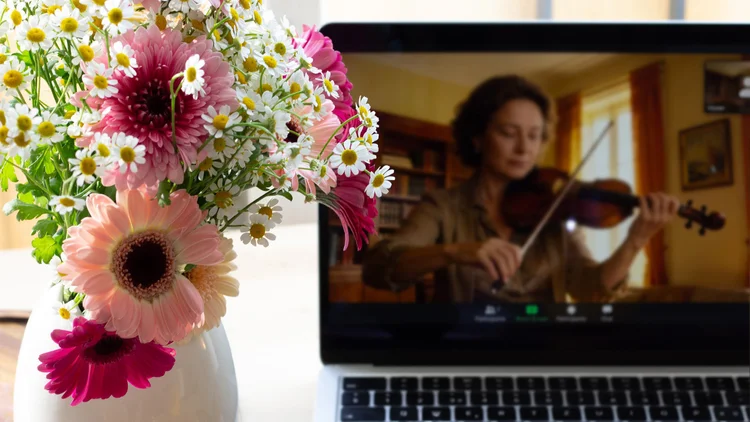
Yes, and for this kind of work the screen is rarely the limiting factor. Intonation, bow contact, the moment a phrase loses direction – these come through clearly on a standard laptop microphone. What matters more is that the goal is to help you hear it yourself rather than to correct you in the moment, so what we find in the session is something you can still use on Thursday morning when nobody is listening.
What if my idea of the problem turns out to be wrong?
That happens often, and it is one of the more useful things a session produces. Adults are frequently working diligently on the wrong hand, and no amount of practice resolves a problem that is not there. Arriving with a theory is genuinely helpful even when the theory is mistaken, because it tells me what you are hearing – and what you are hearing is the starting point either way.
I will have to play, and I am not sure how well it will go under observation.
Almost everyone plays worse in a first session than they do alone, and it makes no difference to the work. If anything the tension is informative – where it appears, what it does to the bow arm, what happens to your breathing – and it is part of what I am listening for. There is nothing to prepare for and nothing to prove. Playing imperfectly in front of someone who is looking for causes rather than faults turns out to feel quite different from playing imperfectly in front of an audience.
Can one lesson change something I have been stuck on for weeks?
It reliably changes what you know about it, which is usually the part that has been missing. Identifying the cause and completing the fix are two different jobs: the first is what a session does quickly, the second is what your practice does afterwards, now aimed at the right thing. Students frequently find that the passage resolves within a fortnight once they stop working on the wrong element.
Do I need to prepare anything?
No, and arriving unprepared is often more revealing. Bring the piece you are working on, or the passage that has been defeating you, and play it the way it currently goes rather than the way you would like it to go. A recording is welcome if you have one, and entirely unnecessary if you do not.
Continue reading