Violin Performance Anxiety: Why You Play Worse When Someone Is Listening
Published August 2026
Why the playing your teacher hears is not the playing you know you have, what changes first when somebody listens, and how to practise being heard rather than hoping your home playing survives it.
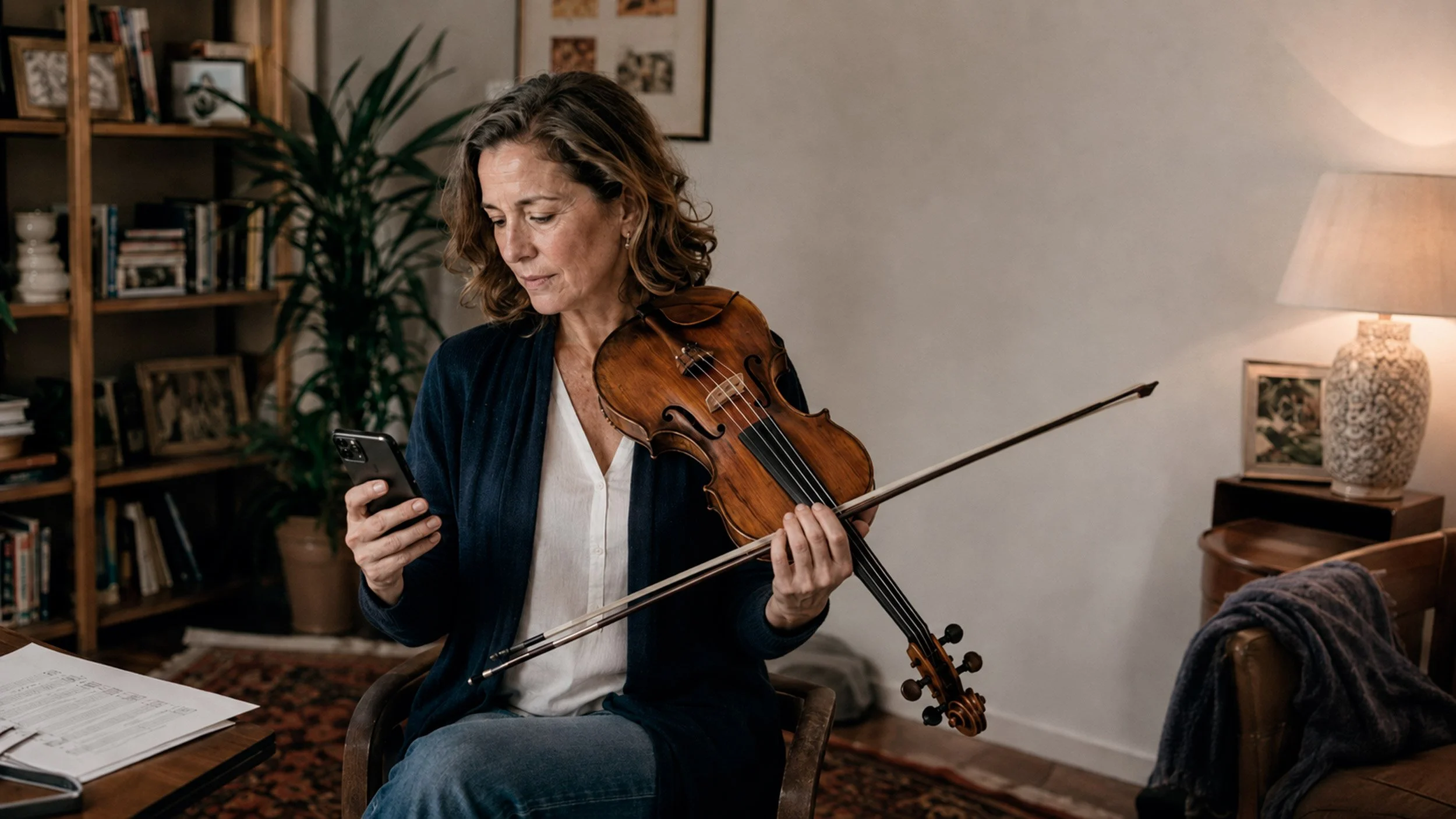
At home the shift works. You walk into the lesson, lift the violin, and the instrument seems to belong to somebody else. The bow is less steady than it was yesterday, the hand misses something it found ten times in a row on Tuesday, and you hear every fault while it is still happening, correcting one while the next is already arriving.
Many adult violinists know this gap intimately. We usually call it violin performance anxiety, stage fright, or plain nerves, and the standard advice follows from the name. Breathe. Relax. Perform more often. Remind yourself that mistakes are allowed. None of that is wrong. It is incomplete, because it treats being listened to as an unfortunate interference with your playing rather than as a change in what the playing is.
Why Do I Play Worse in My Violin Lesson Than at Home?
The sentence it sounded better at home is one of the oldest fixtures of the adult violin lesson. On public violin forums, teachers describe adult students as reliably more anxious than children, and one wrote that without exception every adult student they had taught was a nervous wreck in lessons. Adult learners in the same threads describe bow arms shaking at the tip, minds going blank in scales they have played for months, and a year of lessons in which they believed the teacher had still never heard them play.
That picture deserves a better answer than you are nervous, because at least three situations hide inside the same experience and each calls for a different response. Telling them apart is the work.
Being Heard Changes the Task
Playing for somebody is not home playing with an extra person in the room. It is a different task, and your violin technique does not automatically transfer across the difference. Part of your attention shifts from making the music to monitoring yourself making it. Arousal rises. Most of all, your relationship with error inverts: in the practice room a mistake is information you may stop and use, and in front of a listener it is a thing that has happened and cannot be recalled.
Research finds something measurable here. Erinë Sokoli and colleagues surveyed 186 classical music students aged 15 to 45 at four Swiss music universities, 59 of them string players, and found that self-rated worsening in quality from practice to public performance was best predicted by anxious feelings and breathing-related complaints. The model accounted for about twelve per cent of the variance and the design was cross-sectional, so it proves no cause and leaves most of the difference unexplained. It does support treating I play differently when I am heard as a description of the task rather than a failure of nerve.
Are You Playing Worse, or Hearing Yourself Differently?
You may recognise this: the lesson felt like a disaster, and the recording you were dreading turns out to be ordinary.
The two possibilities feel identical from inside, so this has to be settled first. Sometimes your judgement changes more than your playing does, and the intonation that passed unremarked on Tuesday becomes intolerable on Thursday because you are listening with somebody else's ears.
Recording separates them, and a camera cures nothing. What it does is give you a second source of evidence about a performance you can otherwise judge only from inside. You may discover that something did change, and that it changed less than it felt.
The First-Domino Test: What Changes First When Someone Listens?
Most advice asks how nervous you are, which is a question you cannot answer usefully. A better one is this. What is the first thing that changes when somebody listens?
There is no universal order, and that is why your own order matters. One player notices the bow first. Another rushes. Another loses a familiar shift. Another plays close to normally and experiences the whole thing as a disaster. The question is which change appears first, at which bar, and whether it arrives before the difficulty or at it.
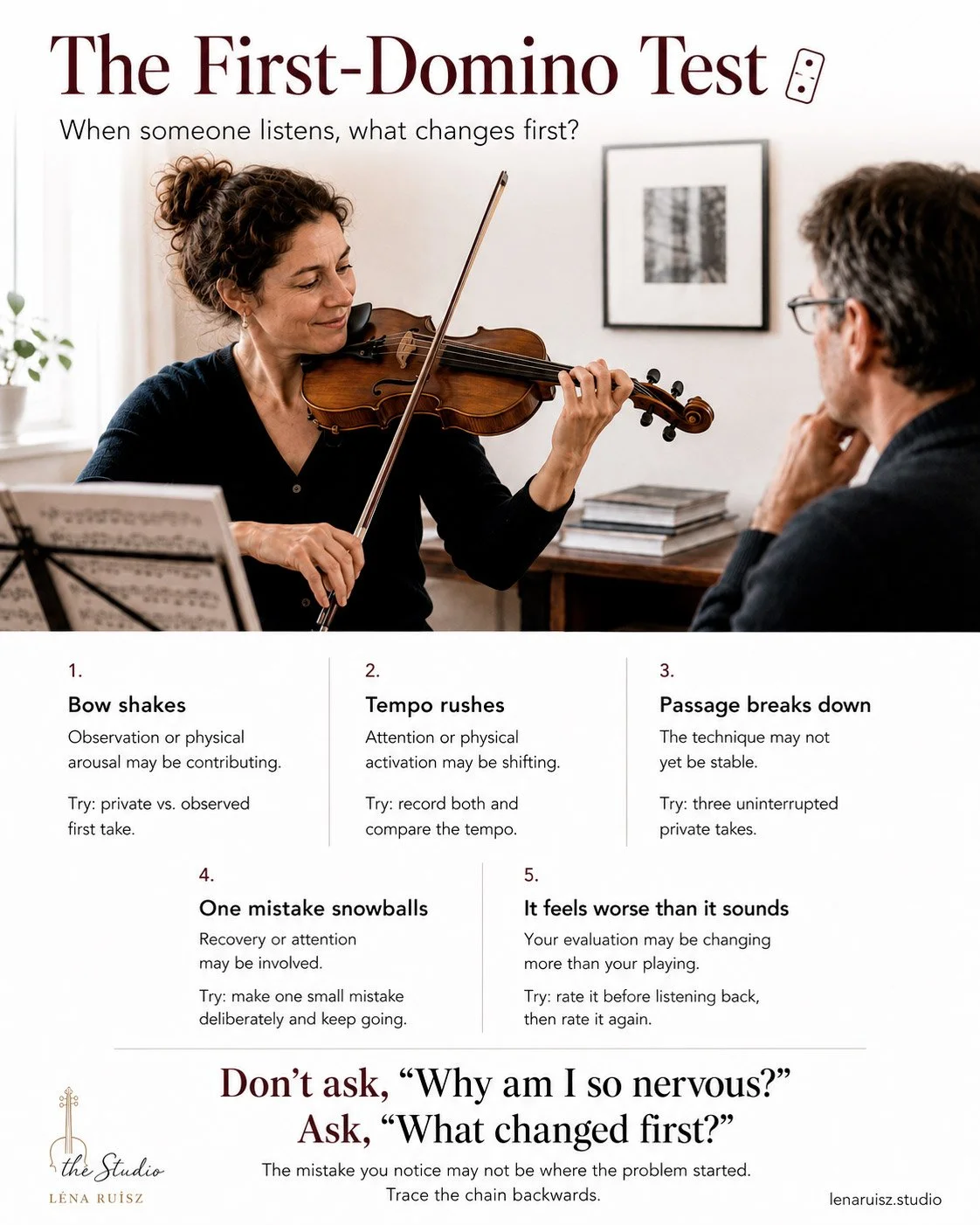
Five candidates cover most of what adult violinists report, and each one suggests its own experiment. If the bow starts shaking before the difficult passage, anticipatory arousal may be involved, so compare a private first take with an observed one. If the passage fails in much the same way alone and observed, the technique may not be stable yet, so play three uninterrupted private takes. If it feels disastrous and the recording sounds close to normal, your self-evaluation may be amplifying the difference, so rate the take before listening and then compare. If one mistake triggers several more, recovery and attention may be part of it, so practise continuing after a deliberate error. And if the first attempt is much worse than later ones, state or observation may be contributing, so compare repeated takes without assuming a cause.
Your own first domino is worth more than any general fact about performance anxiety, because it tells you what to protect. A player whose bow goes first needs a different first lesson from a player whose memory goes first.
Why Does My Violin Bow Shake When I Am Nervous?
Bow shaking is one of the most vivid problems adult violinists describe, usually as a slight tremor at the frog becoming a visible one at the tip. In my teaching, it feels most exposed in slow, sustained and quiet playing, because little musical texture hides it. Gripping harder rarely helps, and more bow speed, a firmer contact point and an opening bar that does not begin on a long exposed note are worth testing, along with the ordinary work of bow control underneath it all.
One caution belongs here, because almost nobody mentions it. Not every bow tremor is anxiety. Richard Lederman documented five string players, four violinists and one violist, with what he called primary bowing tremor, a task-specific movement disorder that appeared distinguishable from essential tremor and from focal dystonia. Five cases is a small series and the condition is rare. It matters anyway, because a bow that also shakes when you are calm and alone is a separate question, and belongs with a doctor rather than a practice plan.
Why Calming Down Does Not Solve Violin Performance Anxiety
Trying to relax can add a third task to a system already running two. You are playing, monitoring the playing, and monitoring whether you are relaxed yet, which is why the advice so often makes the next bar worse.
There is a second reason, and it is the more useful one. Sometimes what appears under observation is not an anxiety response. It is technique that was never stable, and your practice was hiding it. If you stop and restart at every error, you have never played the passage through. If you slow the difficult bars without deciding to, you have never played them at tempo. If you always begin where the good part starts, you have never played an opening cold. A lesson removes all three protections at once.
The lesson is not causing the weakness. It is changing the conditions enough to show you where it already was.
The two point towards different experiments, and often both are present. The useful move is to find out in what proportion rather than to pick a side.
Practising Being Heard: A Graded Sequence
If being heard is a condition rather than an accident, it can be practised. This is a sequence I use with students and in my own practice.
- Record one complete take with no stopping and no second attempt. Listen the following day.
- Send one recording to somebody whose opinion you care about, without commentary and without apology.
- Play one short passage live for one person in the room.
- Play a complete piece for that same person, again with no restarting.
- Rehearse the beginning rather than only the piece. Walk in, tune, wait five seconds and start. Most practice begins after the conditions for beginning have already been solved.
- Raise the stakes by one increment. A second listener, an unfamiliar room, an audience who can see your bow arm.
The progression rule matters more than the steps. Do not wait until a step feels comfortable, because that makes the absence of anxiety the target and will keep you on step one for a year. Move on when you can complete it without escaping, restarting, or losing the ability to recover after a mistake. The aim is functioning while activated rather than eliminating the activation.
Keep a short log, because the log is where the discoveries are. Before each take, write down your anxiety from nought to ten, your predicted quality from nought to ten, and what you expect to change first. Afterwards, note whether you restarted and how long recovery took. Then listen the next day and rate the actual quality. Two or three weeks of that produces sentences no article can hand you: I thought that lesson was a three and it was closer to a six, or the bow did not shake until two bars after the missed shift. That is also the point at which you start to know what to practise next.
Research finds some support for the idea. Isabella Mazzarolo, Kim Burwell and Emery Schubert reviewed nine studies of how music teachers manage performance anxiety and found simulated performance among the four most commonly reported strategies, alongside preparation, positive outlook and breathing. In a 2023 experiment, eighteen string players performed the same excerpt three times in one day before live audiences, and heart rate, self-rated anxiety and expert-rated technical errors all fell from the first performance to the third. Eighteen players on a single day is small and short, and the authors say so. It is a promising signal rather than proof that exposure resolves performance anxiety.
Adult violinists commonly describe one complication worth planning around. Recording is not a gentler option for everybody, and a number of them report a camera producing the same collapse as a listener, along with thirty or fifty takes. If that is you, step one is already the exposure, and deserves the patience of step four.
What a Violin Teacher Can Do With Performance Anxiety
Most people treat a violin lesson as a place where performance anxiety unfortunately shows up. It is closer to the opposite: one of the few places where being heard can be worked on directly, weekly, at a stake low enough to survive and high enough to be real.
In my teaching, what I listen for in the opening ninety seconds is the order, because a bow that begins shaking two bars ahead of the hard passage tells a different story from one that shakes during it. A teacher can then change the conditions deliberately. Listening once through without interrupting is a different test from stopping at every fault. An immediate repeat gives another clue: if something changes dramatically on the second attempt, the problem may not be purely mechanical, and if it fails in the same place and the same way, that points towards a different experiment. Neither result proves the cause on its own. Over weeks the aim is to make being observed ordinary. Whether you need a teacher at all is a separate question, and the useful test is which parts of your own feedback loop still work.
If you already know which thing goes first and cannot work out what it is responding to, that is the point where an outside pair of ears saves you months, and you are welcome to bring the passage to a first lesson.
When Violin Performance Anxiety Goes Beyond Violin Teaching
I am a violin teacher and not a clinician, and there is a line here. Everything above concerns playing that changes when somebody listens. If the anxiety is causing severe distress or panic, substantial avoidance, difficulties beyond music, or physical symptoms that also occur when you are calm and not performing, it deserves assessment by a qualified health professional. Playing technique is one field. What your body is reporting is another.
For the narrower problem this article is about, the first move is information rather than courage. Record one honest take this week and note which thing goes first. Then notice what has changed about the question. You began with I need to play better before I let a teacher hear me, and the useful version is close to its reverse: the way your playing changes when somebody listens is itself information a teacher can work with. You do not have to solve it before you arrive.
Play well alone, then lose it the moment somebody listens?
Bring the passage where it happens. Together we find what changes first, test whether it is technique or the situation, and turn it into something specific to practise. You do not need to fix it before you come. That is the part we do together.
Book Your First Online Violin LessonCommon questions about violin performance anxiety
Why do I play worse in my violin lesson than when I practise at home?
Playing for somebody is a different task from playing alone, so it is reasonable that the result differs. Part of your attention moves from making the music to monitoring yourself making it, arousal rises, and the option to stop and restart disappears. Some of what you hear is a real change and some of it is your judgement shifting, which is why recording both beats choosing between them without evidence.
Why does my violin bow shake when I am nervous, and how do I stop it?
A shaky bow under pressure can have more than one cause, so the instruction to relax your arm is rarely enough on its own. Notice where in the bow it appears, whether it happens only when somebody listens, and which dynamics or bow speeds expose it. In my teaching, the adjustments most often worth testing are more bow speed, a firmer contact point, and not beginning a piece on a long exposed note. If the tremor also appears when you are calm and playing alone, treat that as a separate question for a doctor rather than labelling it performance anxiety.
Can violin performance anxiety be worked on in lessons, or do I have to fix it myself first?
It can be worked on in lessons, within limits worth stating plainly. A teacher can identify what changes first, test an immediate repeat to see whether a fault behaves like an anxiety response or like unstable technique, and build exposure in graded steps. What a teacher cannot do is remove the response in one lesson, and anybody promising that is overstating it. The first useful change may not be that the shaking disappears. It may be that more of the playing survives it.
Should I wait until I play better before I book a lesson?
This is a reason I hear often from adults who postpone lessons, and it makes sense as long as you assume a lesson is an audition. It is not, and the thing you would be waiting to fix is the hardest thing to reproduce alone, because playing under observation requires an observer. Many players tell me they sound worse in a first lesson than at home, and it changes nothing about the work. Where the tension appears, and what it does to the bow arm, is part of what I am listening for.
Do I need to prepare a piece for a first violin lesson?
No, and preparing a showpiece often makes the lesson less useful. Something you have been working on recently is more informative than something polished, because the point is to see what your playing does under observation rather than to hear it at its best. If you would rather not play at all for the first few minutes, that is workable too. Bring the violin, the current piece, and whatever question has been bothering you.
Research used in this article
Sokoli, E., Hildebrandt, H. and Gomez, P. (2022). Classical music students' pre-performance anxiety, catastrophizing, and bodily complaints vary by age, gender, and instrument and predict self-rated performance quality. Frontiers in Psychology. 186 students, cross-sectional.
Mazzarolo, I., Burwell, K. and Schubert, E. (2023). Teachers' approaches to music performance anxiety management: a systematic review. Frontiers in Psychology. Nine studies reviewed.
Candia, V., Kusserow, M., Margulies, O. and Hildebrandt, H. (2023). Repeated stage exposure reduces music performance anxiety. Frontiers in Psychology. Eighteen string players, three performances on one day.
Lederman, R. J. (2012). Primary bowing tremor: a task-specific movement disorder of string instrumentalists. Medical Problems of Performing Artists, 27(4), 219–223. Five cases.
Continue reading