
How I Teach Violin Online: A Studio for Curious Adults
Last reviewed: August 2026
Underneath every first message I receive is the same question – this is where I answer it.
Why This Studio Exists
This Studio exists because at sixteen I walked into a Baroque course in a castle in the Hungarian forest, and something changed for good.
I wanted to understand the violin, from the inside – in context, in history, in sound, in my own hands.
Up to that point I had a very traditional background: scales, études, strict teachers, all the Russian–Prussian discipline you can imagine. It was solid, and I am deeply grateful for it. But something in me was still hungry – for colour, for explanation, for the freedom to make my own decisions without losing structure.
What opened that door was a way of working: things explained rather than handed down, and language for what I had only felt before – why certain phrases want to breathe, why some bowings feel like speech and others like gymnastics, why context makes technique easier rather than harder. Historically Informed Performance is where I found it, and it remains part of how I think and who I am.
That is where I found it. It is not what this studio teaches. Historical practice is part of my musical language and one of several lenses available in a lesson. When the useful question is intonation, bow arm, repertoire, tension, confidence or how to structure a week of practice, we work there instead, and nothing about historical playing has to interest you for the lessons to be worth your time.
This Studio is where all of that comes together – my work as a performer, my master's in music pedagogy, my research into historical practice, and years of teaching adults who are curious, thoughtful, and very much not beginners at life.
Who This Studio Is For
I built this space with a very specific person in mind. You might recognise yourself in one of these:
- You played as a child or student, then life happened, and now you feel the violin is calling you back.
- You already play, perhaps well, and suspect there is more to phrasing, colour, and style than you were taught.
- You are starting later in life and wondering if you are allowed to begin now.
- You are intellectually curious and slightly allergic to dogma.
If you like to think, to ask questions, to connect ideas, then we already share a language. For anyone coming back to the violin after years away, I write about that particular return in Rediscovering the Violin in Adulthood.
What I look for in a student is curiosity. Age and level matter far less.
What You Probably Worry About
Most first messages I receive sound something like:
- "I have not played in years, is it too late?"
- "I am mostly self-taught, is that a problem?"
- "I am already a professional, what if you find all the things I do 'wrong'?"
Underneath all of these is the same question: am I good enough to deserve this?
My answer is always the same: this is not an audition. You do not have to arrive "in shape." You do not have to reach a mysterious minimum level before asking for help. The first session's only requirement is that you show up as you are, with an instrument, a bit of time, and a mind that is willing to explore. The rest is my job.
How It Feels to Learn Here
If you sat invisibly in the corner during a lesson, you would probably see:
- a lot of conversation
- some very focused listening
- occasional laughter
- experiments that sometimes work and sometimes need a second try
- small technical corrections that grow from musical ideas
I do not teach by tearing anyone down. You will get honest, specific feedback, but never at the cost of your joy or dignity. I am not interested in sarcasm, shaming, or "breaking" a student to rebuild them.
How I want you to feel during and after a lesson: curious – you understand more than before, and you want to try it. Challenged – invited to grow at a size you can meet. Ready to go – you know exactly what to experiment with until we meet again.
Some students need detailed explanation. Others learn best by trying and feeling. Part of my role is to adapt – to find the language, metaphors, and exercises that make sense to your particular brain and body.
Underneath the adapting there is one constant. Most of what I teach is how to hear what your own playing is doing, so that the decisions you make between lessons rest on evidence rather than on hope. A lesson that leaves you better able to work without me has done its job.
Your Body, Your Setup, Your Sound
I care deeply about how you and your instrument coexist. When you play for me, I look at how the violin sits on your body, what your bow arm is doing rather than what it means to do, where your breathing is free and where it vanishes, and which parts of you are doing far more work than necessary.
Sometimes a small change is enough. A different balance point, a lower shoulder, a clearer idea of where the phrase is going. Each of those is a test rather than a cure, because tension is a symptom before it is a diagnosis.
None of this is about a single ideal posture. It is about finding the setup and the movement that let you play with ease, for as long as you want to keep playing. Nothing is imposed for its own sake, and you will always understand why we are trying a thing before we try it.
How We Work Online
Online lessons are the core of this studio, and they began out of ordinary life. Working with my students, I found we could hold a steady weekly rhythm even while I was touring, and even while they were with family, on holiday, or away for work. What began as a necessity turned out to be one of the best parts of how I teach.
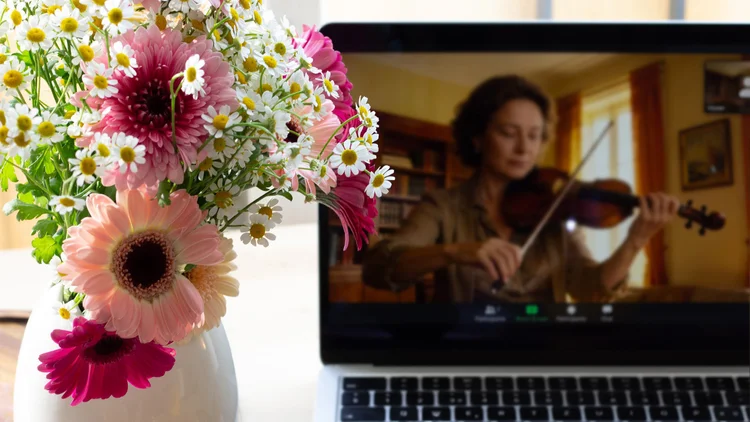
You need a violin, a laptop or tablet, a reasonably stable internet connection, maybe headphones, and later perhaps a simple microphone. We work together on Zoom – simple and reliable. At the start, we take a few minutes to set up sound and camera together, so you are not alone with the tech side. If the internet misbehaves, we troubleshoot or reschedule. Mildly annoying, yes. A disaster, no.
Online teaching has a few unexpected advantages. You hear yourself more honestly – you cannot lean only on my ears. You become more independent in the practice room, because you learn to notice more. You can record parts of the lesson and watch them again when you forget exactly what your hand did when it suddenly felt easy.
If you want a deeper sense of how this works in practice, I talk about progress, focus, and sound through a screen in Why Online Violin Lessons Work Better Than You Think.
Who I Am, and What I Bring
Elsewhere on this site you will find the formal biography – the festivals, the ensembles, the conservatoires, the scholarships. All of that matters, because it shows I live this life fully as a performer and researcher. But for this page, what matters most is what all of that experience gives to you.
I have played under, beside, and in front of some of the most inspiring musicians in Europe, and I pass that knowledge on. I have worked through the lonely parts of practising, the injury scares, the motivation dips, the "am I doing any of this right" moments – and I am very open about them. I am currently researching how a person becomes self-directing, and whether self-management can be taught, as an interdisciplinary study between management and music pedagogy.
My master's in music pedagogy included a supervised teaching practicum at the Musik-Akademie Basel, where I taught across the whole range, from young children to university master's students. That work trained me as much in how a person learns as in how the violin works.
I see teaching as a collaboration. I bring my ears, experience, and slightly nerdy love of context. You bring your curiosity, your questions, and your life so far. The lessons happen where those two meet.
What I Can and Cannot Promise
What I can promise: I will take your playing and your time seriously, whether you are a beginner, a returning adult, or a professional. I will do everything I can to keep curiosity alive – to give your practice structure and freedom at the same time. I will be honest and clear, but always on your side.
What I cannot promise: that this will always feel easy; that there will be no moments of frustration or doubt; that you will wake up playing like your favourite soloist after three lessons.
What I can say, from experience, is that if you bring an open mind and a reasonably consistent habit, you will change – in how you hear, how you move, and how you think about music.
If something in this page feels like recognition – if you see your own questions here, or feel that small click of oh, this is how I want to learn – then you are exactly the kind of person this studio is for.
Begin with one lesson.
A full working lesson – we begin with your instrument, your questions, and your musical curiosity. You leave with something you can use the same day. No commitment beyond that is required.
Book Your First Online Violin LessonBefore you book
What kind of student do you work best with?
Curiosity, more than level or age. I work with returning adults, adult beginners, experienced amateurs, and professionals who want a sparring partner. What they share is a willingness to think, ask questions, and connect ideas.
How do you structure lessons for adult learners?
Each lesson is built around what matters most that day – sometimes a technical habit, sometimes a phrase, sometimes a setup question. We always leave with one or two specific things to experiment with before we meet again. I adapt to how you think and learn, not the other way around.
How does online teaching work for something as physical as violin?
Better than most people expect. Intonation, articulation and bow contact come through clearly enough for detailed work, and a well-placed camera shows the bow arm and left hand plainly. What a screen cannot do is adjust you physically or play with you in time, so we work through demonstration, description and observation instead, and you learn what a position feels like from the inside.
Can professionals benefit from these sessions too?
Yes – some of my most productive sessions are with professionals who want a different perspective on sound, or preparation for a recording or audition. Sessions become a space to think out loud with someone who speaks the same language.
Continue reading
© 2026 Léna Ruisz. Text and images may not be reproduced without permission.